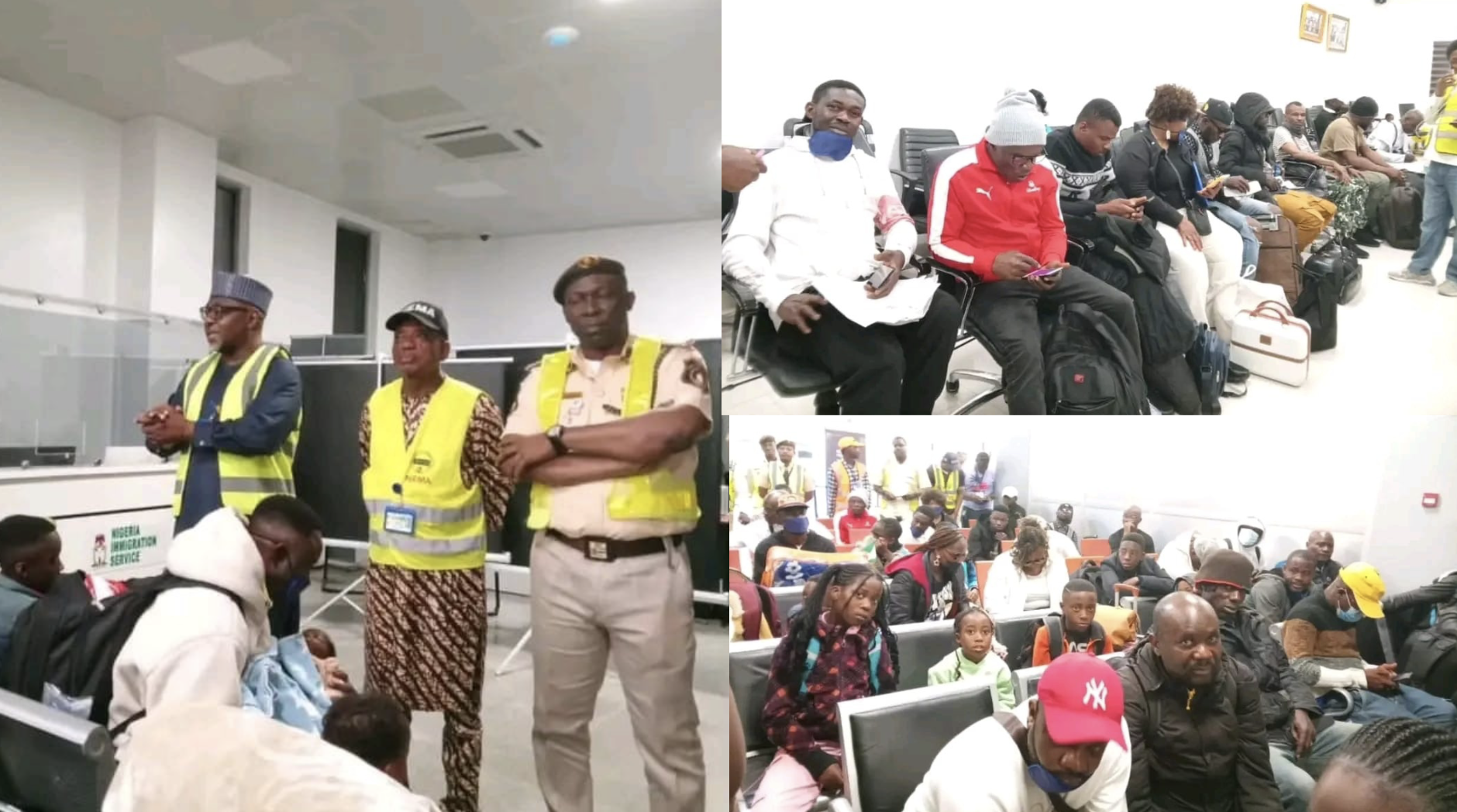
Eighty-three Nigerian nationals have landed at Murtala Muhammed International Airport in Lagos, traveling on a South African Airways flight from Johannesburg as the repatriation of Nigerians from South Africa continues.
Upon arrival, the returnees were welcomed by Ambassador Haruna Ali-Gombe, the Director of African Affairs at Nigeria’s Ministry of Foreign Affairs, representing the Federal Government.
They were then handed over to the appropriate government agencies for documentation and profiling before being reunited with their families.
This latest arrival follows a wider repatriation and evacuation initiative for Nigerians currently in South Africa.
In June, South Africa’s Department of Home Affairs confirmed it had processed 586 Nigerian nationals for repatriation after identifying their illegal residence in the country.
The first official repatriation flight departed South Africa on June 11, 2026, carrying 268 nationals.
These individuals were issued Emergency Travel Documents by the Nigerian High Commission and classified as undesirable according to South Africa’s Immigration Act, which imposes a five-year entry ban into the country.
This initiative was distinct from Nigeria’s voluntary evacuation program, which was initiated amid concerns regarding xenophobic attacks and rising anti-immigrant sentiments in South Africa.
The initial Nigerian evacuation flight landed in Lagos on June 11, followed by subsequent flights bringing back hundreds more nationals.
By mid-July, Nigeria reported that 1,490 citizens had been evacuated from South Africa through a series of flights operated by Air Peace and South African Airways.
The National Emergency Management Agency (NEMA) later indicated that between June 11 and July 15, 1,516 vulnerable Nigerians had returned voluntarily.
The Nigerian government has reiterated its commitment to prioritize the safety and welfare of its citizens, especially in light of reports regarding xenophobic violence.
Nigerian authorities have also challenged the blanket labeling of their nationals as undocumented, asserting that some legally residing Nigerians have encountered issues with permits and documentation.
In turn, the South African government has persisted with its broader immigration enforcement efforts aimed at undocumented foreign nationals.
As of August 3, 2026, South Africa reported that 77,184 undocumented foreign nationals had been repatriated to various countries, with 18,816 formally deported from April to July.
Thus, the arrival of these latest 83 Nigerians occurs within a complex immigration landscape characterized by voluntary returns, humanitarian evacuations, and formal deportations of undocumented migrants.
The returnees will undergo necessary documentation and profiling processes before reuniting with their families.