 South Africa is grappling with a significant municipal water crisis, with 47.3% of processed drinking water classified as lost or unbilled, known as Non-Revenue Water (NRW).
The main factors contributing to this issue include aging infrastructure, pipe leaks, inaccuracies in metering, and unauthorized connections.
Each year, approximately 1.44 billion cubic meters of water are lost due to physical leaks in the national pipeline, an amount that equals over half the capacity of the Vaal Dam or the total annual water use of the Western Cape.
This information comes from the 2026 No Drop Progress Report, which shows that nationwide water losses total 1.81 billion cubic meters annually, costing about R26 billion each year.
The situation is exacerbated by failing sanitation systems, with 47% of municipal wastewater treatment facilities deemed critically deficient, leading to over 100 legal actions against non-compliant municipalities.
This arises from systemic issues in municipal management, a severe lack of skilled technical personnel, poor maintenance practices, and the misallocation of water revenue intended for infrastructure maintenance.
Deputy Minister of Water and Sanitation Jack Bloom informed Talk Radio 702 that approximately 30 to 40% of the nation’s potable water is wasted in public areas.
Bloom attributed much of the wastage to issues in municipal management, corruption, and deficiencies in leadership.
He noted that when municipalities are allocated water funding, it often gets redirected to other expenses.
Bloom stated that legislative amendments are underway to ensure that these funds are exclusively used for water services, thus addressing the issue of leaking pipes.
He further discussed the failures in wastewater treatment, which have led to severe pollution and sewage leaks.
“Our waterways are terribly polluted with sewage spills, mostly from malfunctioning wastewater plants. 47% of them have been found to be in a critical condition,” he said.
Bloom described the situation in the Vaal area as “absolutely appalling.” The Department of Water and Sanitation is collaborating with Rand Water to form a special purpose entity to tackle these challenges.
He underscored the need for partnerships between public and private sectors and the implementation of new sanitation technologies, advocating for a “sanitation revolution.”
“We have to use the latest technologies, we need to decentralise sanitation, we need to do a lot more water recycling and water conservation, and we’ve just got to be water-wise because we are a water-scarce country and it costs an enormous amount of money to build dams and to get water,” he explained.
More than half of all municipal wastewater systems across the country are in critical condition
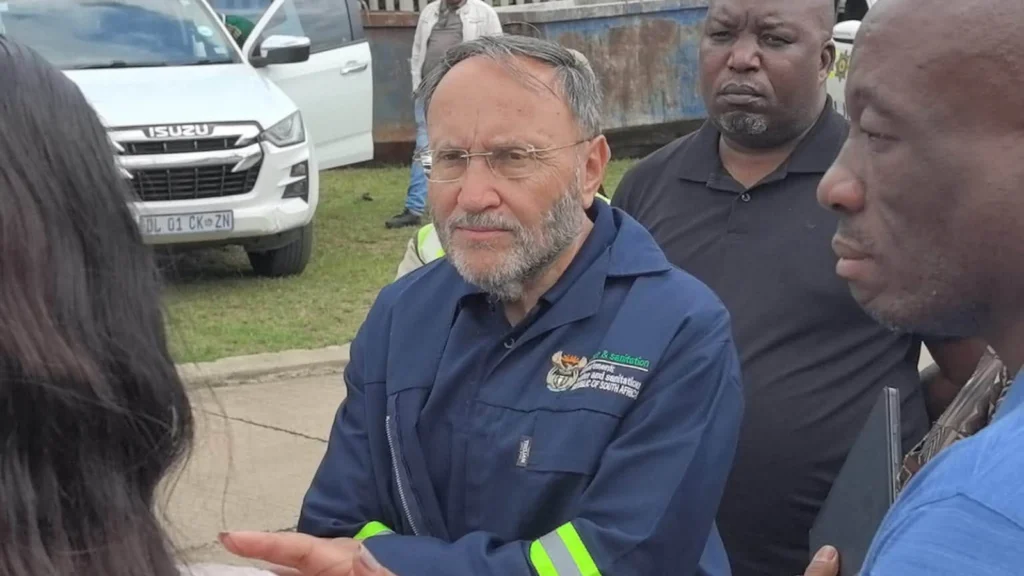 Deputy Minister of Water and Sanitation Jack Bloom
The report from the Department of Water and Sanitation indicates that the national average for non-revenue water (NRW) has not significantly changed since the 2023 No Drop Report.
The Department observed that while NRW levels appear to have stabilized, they remain unacceptably high.
Additionally, it noted that the condition of wastewater infrastructure is steadily worsening, with 61% of municipal wastewater systems currently categorized as critical or poor.
The Free State and Northern Cape continuously rank as the lowest-performing provinces.
The Free State is experiencing a critical failure in sanitation, as 98% of its wastewater treatment facilities are rated as poor or critical.
The Northern Cape exhibits the highest rate of physical pipe leaks in the nation, at 44%, along with the most concerning drinking water safety profile.
KwaZulu-Natal and Mpumalanga are the provinces that lose the most municipally supplied water, with each losing about 60% to leaks, theft, and billing inaccuracies.
Provinces such as the Northern Cape, Limpopo, and North West have shown the least accountability in administration, consistently submitting inadequate corrective action plans to address their water losses.
The Western Cape is at the forefront of several water management indicators, including boasting the lowest physical leak rate at 19.2%, the least Non-Revenue Water rate at 28.5%, and the lowest per-capita water consumption rate at 169 litres per capita daily (l/c/d).
This province also maintains a 100% compliance rate in submitting necessary regulatory Corrective Action Plans.
In contrast, Gauteng, which is notably smaller than the Western Cape, consumes the most water, totaling 1.59 billion cubic meters annually, and records the highest daily per-capita usage at 243 l/c/d.
Despite Gauteng’s relatively lower physical leak percentage of 27.1%, due to its size, it experiences an annual clean water loss of about 431 billion litres, a volume almost equal to the entire yearly water supply of the Western Cape.