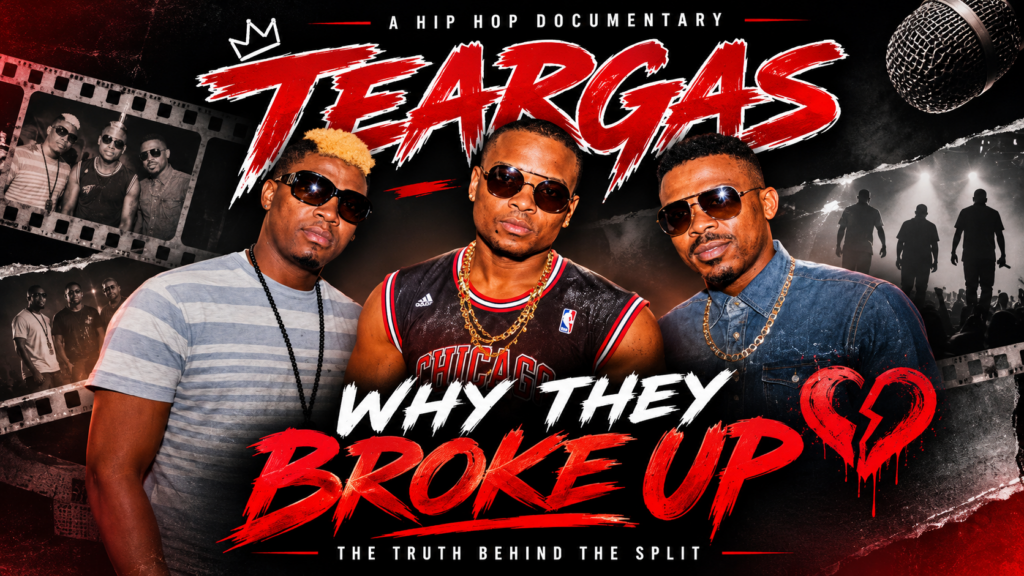
Teargas is recognized as one of the most impactful groups in the history of South African hip-hop. Songs such as “Chance,” “Mhlobo Wami,” and “Wake Up” continue to resonate with audiences, prompting enthusiastic sing-alongs nearly two decades after their release. The group reached significant highs, both critically and commercially, a feat that few local acts have replicated. Nevertheless, internal strife ultimately led to their disbandment, largely due to the emergence of Cash Time Life.
Formed in 2004, Teargas quickly secured a recording contract. Their debut album, K’shubile K’bovu, launched in July 2006, received a warm reception. The single “Chance” garnered a nomination for Song of the Year at the 2007 South African Music Awards. Their follow-up album, Wafa Wafa (released on 15 May 2008), creatively merged hip-hop with kwaito influences and won Best Rap Album at the 2008 SAMAs. The third album, Dark and Blue (2009), achieved gold status by selling 25,000 copies in South Africa and was nominated for Album of the Year at the 16th Annual SAMAs. In 2010, the group received a nomination for Best International Act at the BET Awards. Years later, in 2022, they released Number Number, which topped South African music charts and received several nominations.
With four albums, numerous awards, and gold certifications, Teargas was regarded as a leader in South African hip-hop. However, this success did not shield them from disputes.
Cash Time Live: The Breaking Point
The source of the tension lay in the creation of Cash Time Live, a South African music publishing and record label. The wider Cash Time Fam collective included artists like K.O, Ma-E, Maggz, Kid X, Moozlie, AB Crazy, Smashis, and DJ Vigilante. For members of Teargas, the label held both promise and a lasting source of discord.
In an interview with SA Hip Hop Mag, Ntukza expressed feeling marginalized. “The week before that actually happened, unfortunately, we had that meeting, and at the meeting they asked me, do I want to be a part of this? Because they feel like I don’t want to be a part of this Cash Time thing. I said, yeah… But next week, the script changes. I see a paper, I’m not even being engaged into the thing… The least that I need you to do is to respect me.”
K.O. provided a contrasting account. In his conversation with SA Hip Hop Mag, he dismissed allegations of Ntukza’s exclusion or unfair treatment. “It’s on paper. People know this shit… It was presented to all of us… We’re about to start this Cash Time shit… As far as the directors, it’s the four of us. Cash Time gonna have four directors, and this bitch gonna be split 25% each. Four ways… We said, yo, so here’s your stake, come do this shit. And the niggas flat out said, fuck no… And we had to respect that, and it ended up being three directors… myself, Ma-E, and it was split equally still… I was never trying to pull a fast one on no one.”
Two members. Two differing narratives. Fans left to discern the truth between the accounts.

Reunion Hopes and Lingering Distance
Over time, fans have frequently wished for a reunion on stage. However, these plans have yet to come to fruition. Talks about a “Back to the City” performance underscored unresolved disagreements. Ntukza has expressed openness to reconciling differences for the greater good, highlighting the persistent interest from promoters. Yet, he has also emphasized his focus on his individual endeavors.
K.O. has also been straightforward regarding their ongoing distance. He mentioned that he had not communicated with Ntukza since 2018, and prior to that, not since 2014. A prior attempt to discuss a reunion in 2018 fell apart amid public disagreements and personal remarks. Regarding the possibility of a 2022 performance, K.O. stressed that any appearance by Teargas would need to be authentic and that the group’s founding principle of equal earnings would remain his benchmark.
The Question That Remains
Will South African audiences ever witness a live performance of “Wake Up” and “Chance” by Teargas together again? The likelihood appears slim in the near future. Their artistic legacy is firmly established, yet the personal and business rifts that contributed to their split have proved more lasting than their popular tracks.
What endures is the music and the discussion it inspires. Which perspective on the Cash Time narrative resonates more with you? Share your favorite Teargas track in the comments and stay engaged with SA Hip Hop Mag for further explorations into the evolution of South African hip-hop.