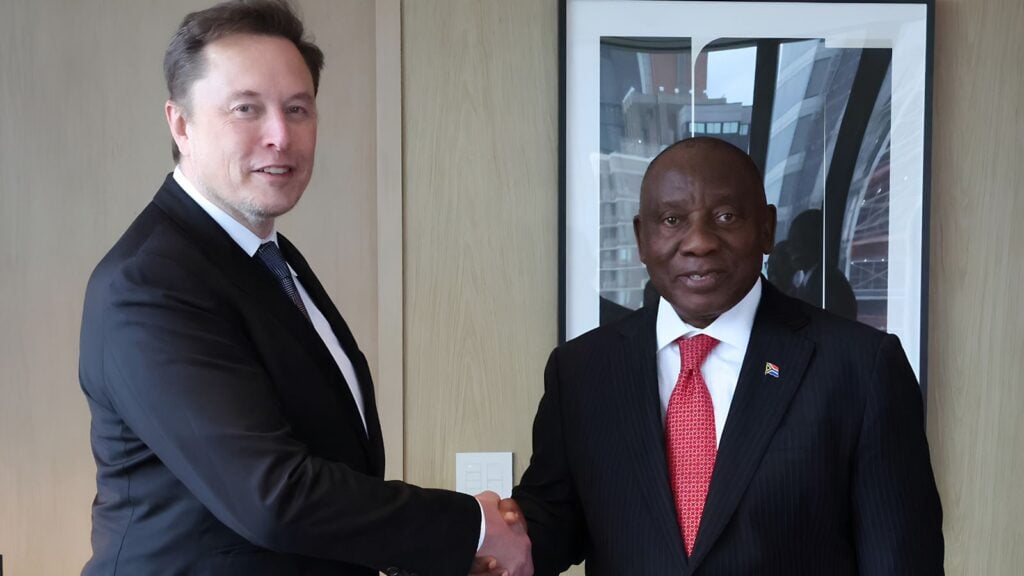
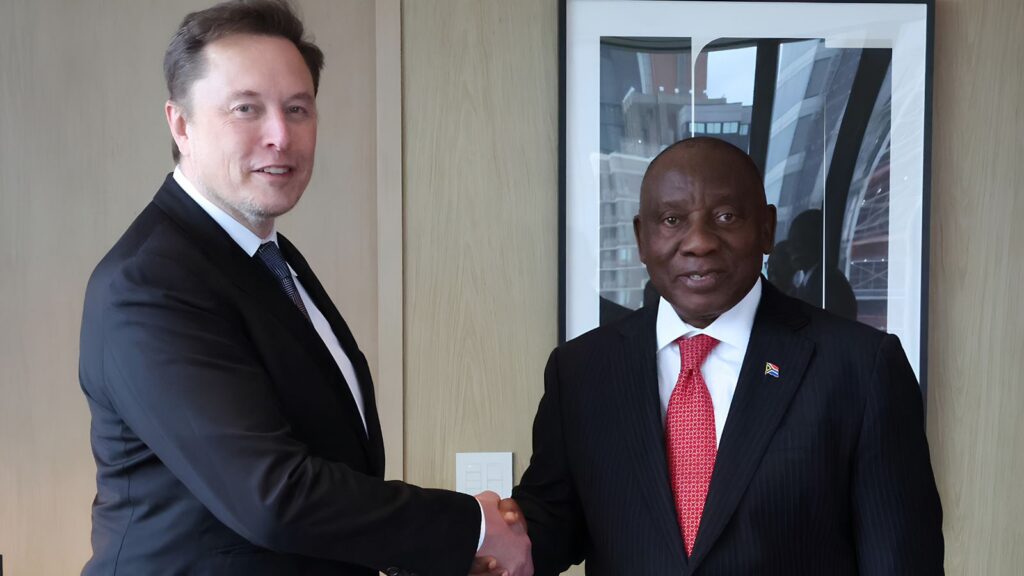
 President Cyril Ramaphosa has urged billionaire Elon Musk to remember his origins in South Africa and to lend his support to the nation’s development.
He emphasized that a significant part of Musk’s success can be attributed to his education and experiences in South Africa.
This statement emerged during an interview with Jonathan Karl, ABC News’ Chief Washington Correspondent, as Ramaphosa visited Silicon Valley on a working trip.
According to Ramaphosa, Musk should acknowledge the influence of his South African upbringing and education in his career journey.
The president recounted his past meetings with Musk, expressing admiration for his talents and stating that he had been “awed by his brilliance.”
However, Ramaphosa expressed a desire to discuss Musk’s connection to South Africa.
“I would like to chat to him about him remembering his country because even as one is a citizen of a new country, you should still be loyal to your old country,” Ramaphosa stated.
Musk, having been born and raised in South Africa, has risen to prominence as one of the wealthiest and most impactful entrepreneurs globally. Yet, his outspoken critiques of South Africa’s transformation policies, notably those focused on black economic empowerment, have led to tensions with the South African government.
Karl inquired about Musk’s earlier assertion that Ramaphosa was establishing “apartheid 2.0,” asking the president to reflect on such comments, especially in light of his own experiences with apartheid.
Ramaphosa suggested that Musk may not fully grasp the lasting repercussions of apartheid on black South Africans.
“I think Elon, I mean by nature, is very conservative, and he doesn’t fully understand the extent of what the apartheid policies did to black South Africans,” he commented.
He added that Musk’s identity as a white South African might lead him to overlook the systemic inequalities caused by the former regime.
“And I think he, being a white South African, maybe has not really appreciated and come to understand the harm that apartheid policies did,” Ramaphosa remarked.
Musk must accept BEE rules if he wants to launch Starlink in South Africa
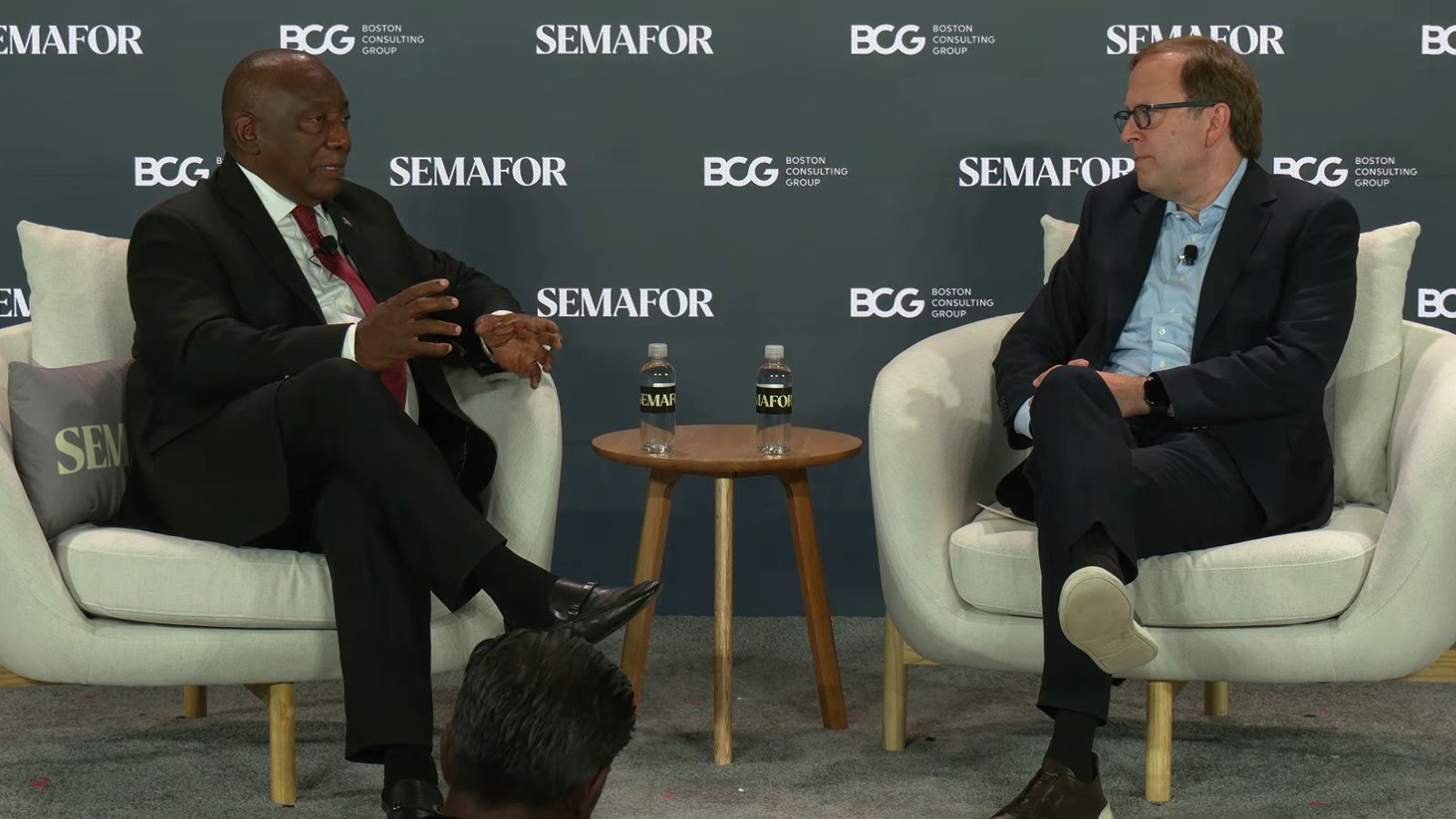 Ramaphosa in an interview with Jonathan Karl, Chief Washington Correspondent at ABC News
Ramaphosa explained that apartheid intentionally privileged white individuals through systematic legislation, institutional practices, and access to resources, including education.
He illustrated this disparity by contrasting government education funding during apartheid, noting that while R12 was allocated to Musk’s education, only R1 was dedicated to his own.
“When the apartheid government spent R12 on his education, it spent R1 on my education,” Ramaphosa noted.
He argued that a comprehension of this historical inequality is crucial for understanding why corrective measures are necessary today.
“If one does not understand that, one will never be able to understand precisely what needs to be done to remedy the harm that was done,” he stated.
When asked what he would say directly to Musk if the billionaire were present, Ramaphosa referenced the critical role of South Africa in shaping Musk’s achievements.
“I mean, I would say to Elon what you’ve become today is by dint of your own origins, where you were initially educated when you started dabbling with these game machines,” he elaborated.
“It is because of the knowledge and the education that were made available to him.”
Ramaphosa asserted that the skills and knowledge Musk acquired during his early years were influenced by his South African background, encouraging Musk to give back to the nation.
“And it is this endowment that he now has that was formed in South Africa, and he should be one of those who would say I would like to contribute to the development of South Africa and give back to this country that made me who I am today,” he remarked.
These comments arise amid ongoing disputes between Musk and the South African government concerning the operational requirements for his satellite internet enterprise, Starlink.
When asked about the potential for Starlink to launch in South Africa, Ramaphosa confirmed that negotiations had occurred, focusing on adherence to the nation’s regulations for foreign companies.
He mentioned that Musk has found it challenging to understand the government’s stance, reiterating that international companies must comply with local laws.
“All countries have policies in terms of how they admit companies to operate,” Ramaphosa explained.
“The United States has the same. It has its own policies, and when you want to come and operate here, you’ve got to subscribe to the policies of the country.”