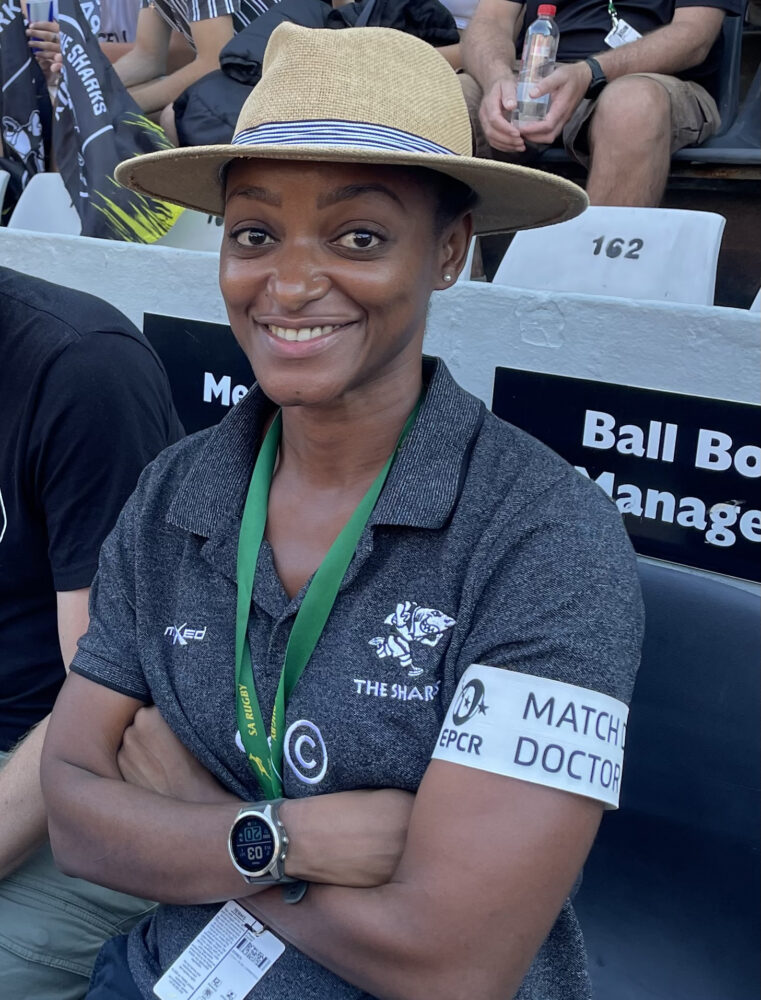
Advantage: Physician Phathokuhle Zondi recognised early that she could harmoniously merge her two passions – athletics and healthcare. Photo: Supplied
From the edge of top-tier rugby arenas and the Olympic Games to executive offices within sports and educational organizations, Phathokuhle Zondi has tackled significant challenges in establishing her role as a female physician in sports medicine.
Zondi, who is 42 years old, specializes in sports and exercise medicine, having collaborated with numerous prominent South African athletes and smashed gender stereotypes by becoming a junior medical officer for the Blue Bulls rugby team at just 27.
Her career then advanced, leading her to serve as the medical officer for the 2012 Junior Springboks team, which included future Rugby World Cup champions such as Handrè Pollard, Pieter-Steph du Toit, Bongi Mbonambi, Jesse Kriel, and Vincent Koch.
Zondi earned the prestigious position of chief medical officer for Team South Africa at the 2014 Commonwealth Games, the 2016 Rio Paralympics, the 2017 World Games, and the 2020 Tokyo Olympics, where she had the opportunity to work alongside Caster Semenya.
At the age of 33, she took on the role of chief executive of the Sports Science Institute of South Africa, where she remained for four years.
As the chairperson of the Medical Advisory Commission for the South African Sports Confederation and Olympic Committee from 2016 to 2024, she has influenced athlete care and set clinical standards. Additionally, Zondi held the presidency of the South African Sports Medicine Association from 2015 to 2017.
Zondi’s swift rise in the field of sports medicine has positioned her as a pioneer in an area traditionally dominated by men. Her enthusiasm for sports stems from a family background rich in athleticism, with her father participating in four Comrades Marathons, reinforcing her belief in the transformative power of sports.
“I was always very sporty. And at some point it was more than an interest. It was, like, I just love it. I love who I am on the field, what it makes me in terms of the connections, the friends, the contacts,” she said.
She was drawn to biology during her school years, excelling in a setting that pressured young individuals to pursue careers as “you must be a doctor, a lawyer or an accountant, out of those three being a doctor appealed to me the most.”
“My sister heard an interview on SAFM with Tim Noakes, the father of sports medicine, and she said, ‘You have to listen to this.’ I realised, oh my goodness, here is a career that combines these two passions of mine. And from that time, I knew it was what I wanted to do and it has not disappointed,” she said.
Zondi completed her medical degree at the University of Cape Town, followed by a master’s in sports medicine at the University of Pretoria, and she also earned an MBA from the Gordon Institute of Business Science.
The pivotal support in her career came from her mentor, Professor Christa Janse van Rensburg, who supervised Zondi in the sports medicine department at the University of Pretoria and recommended her for the junior medical position at the Blue Bulls.
“When she first asked me, I laughed. I was, like, do you see me? No, it’s not going to work,” Zondi recollected.
This phase was challenging for her as a black woman striving to establish herself in a predominantly white male profession. However, this opportunity opened numerous doors that she had not previously expected.
“I found myself at the Blue Bulls through the encouragement of my then mentor and supervisor. It was a very ‘interesting’ period,” she said.
“When I entered there obviously it was a very Afrikaans environment. I felt out of place, this black, young woman — and I had dreadlocks,” she reminisced.
“Players [would] go for a second opinion from their house doctor, their GP, while I was a specialist.
“Initially, I was quite offended. Literally nine out of 10 times they would come back to me and say, ‘My house doctor says you’re right.’ But at some point… I just realised they’re not doing this because they know me; they’re doing it because they don’t know me.”
Zondi also shared experiences of being confused for a physiotherapist or massage therapist on the field.
“We’d even go to hospitals if we were playing away, and I’d say I am Dr Zondi and hand over my patient to the doctor and, especially if they were Afrikaans and male, they would turn and speak to my male manager instead.”
“It was hard but at the same time it was probably the most formative years, and I couldn’t have asked for a better learning ground than at the Blue Bulls, and it really ended up being a platform for the rest of my career.”
Zondi noted that, despite the cultural challenges, she received exceptional support from the team’s management.
“I realised that I really love rugby and the actual performance environment speaks exactly to my characteristics and my strengths. I went from there to become a team doctor for the 2020 Junior Boks. And then from there, I started working with World Rugby as an educator, and then senior educator and trainer, training doctors, which is what I do now on a regional basis.”
A pivotal moment in her career occurred when she was invited to join World Rugby’s medical educator programme, just six weeks post giving birth.
“I said, ‘I can’t come unless I bring my baby.’ And the manager said, ‘That’s fine, bring your nanny too.’ That is what women need. Opportunities — and environments that allow us to show up.”
Recently, Zondi was chosen to oversee the medical expert team contributing to Athletics South Africa’s case against the International Association of Athletics Federations (IAAF), contesting the proposed Eligibility Regulation for Female Classification. This case was presented at the Court of Arbitration for Sport in February 2019.
The ruling concluded that the IAAF’s requirements, which mandated athletes to lower their testosterone for participation in certain events, were necessary and proportionate despite being regarded as discriminatory.
This regulation implies that athletes like Caster Semenya, diagnosed with 5-alpha-reductase deficiency, would have to undertake medication to diminish their testosterone to partake in international competitions in distances of 400m and a mile.
Zondi expressed that the medical community is still navigating the complexities surrounding gender, human rights, and fairness in sports.
“It’s very controversial, because I think the issue is not a simple one. There are human rights matters and then there’s obviously issues related to fair play and creating an environment that protects women, females,” she said.
“I think on the issue of human rights, there’ll be unanimous concern that one needs to accept individuals for who they are, however they relate and how they want to show up. But there is a complexity when it comes to sports performance, specifically, if you understand the biology and even the physiology of performance and how hormones may influence physical performance.
“For a male who has gone through puberty, there are many performance advantages that take place and for a man who becomes transgender after puberty there is evidence that there may be a performance advantage. If the change happens before puberty, that is more questionable,” she stated.
“I don’t know what the solution is and I think the sports world at large is still debating how to accommodate human rights matters, while also being mindful of the performance advantages of men who become women after puberty,” Zondi stated.
She reflected on the obstacles that still hinder women’s progress in sports.
“The first challenge is being given a seat at the table. Unfortunately, the way many of our governance and other structures are constituted right now, women are still in the minority, so there’s no parity.
“In other words, you do have to receive invitations to the table to be given opportunities, both field-side and in everything from doctors, physios, team management, sports sciences, to governance and administrative positions.
“There is to date no parity in terms of equity within those roles, and even in terms of research, because committees are largely still dominated by men.”
The second concern is financial disparity.
“Having worked in certain governance structures and looking at the financials, women are not paid the same as men. And again, this is on the field, the athletes themselves as well as support personnel and leadership.”
Zondi advocates for equal opportunities to be provided in settings where women can flourish, acknowledging that they can also balance motherhood.
This vision of reconfiguring systems to support — rather than sideline — women is central to her ongoing efforts.
As a mother of two daughters, her objectives are both professional and personal.
“I’m committed to creating a world where my daughters can thrive despite their race or gender,” she remarked. Zondi recently began her role at the University of KwaZulu-Natal as an academic in the School of Clinical Medicine, aiming to enhance the institution’s research and instruction in sports and exercise medicine.