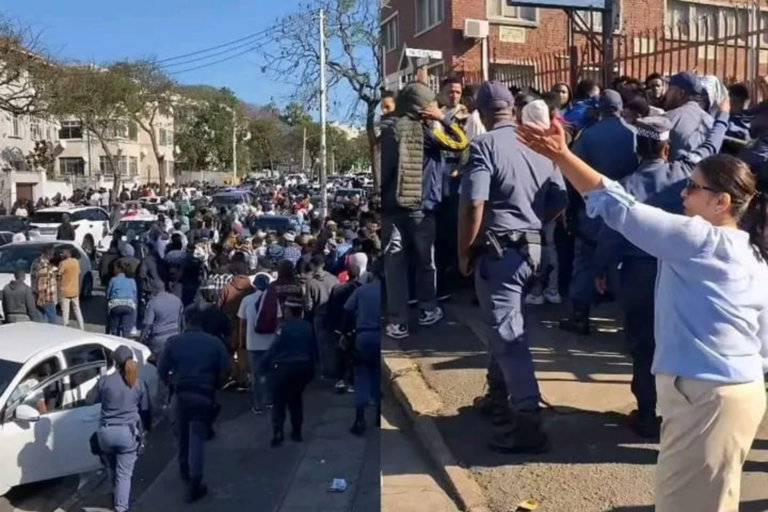
On 17 September 2025, South Africa’s eagerly awaited Madlanga Commission commenced, heralding what could be a pivotal public inquiry in the nation’s recent history. By Day 108, the proceedings felt more akin to a gripping narcotics drama than a formal legal investigation. Lieutenant Colonel Nkoana Joseph Sebola, a long-serving member of the South African Narcotic Enhancement Bureau (SANEB), detailed a drug operation that was jeopardized by individuals sworn to uphold the law.
The account began on a chilly winter morning, 9 July 2021, when Sebola was alerted to a chaotic incident taking place at a Scania warehouse in Aeroton. Upon his arrival at 11:30, he discovered not just a criminal situation, but a standoff. A marked police vehicle from Booysens effectively blocked a black Nissan bakkie that was attempting to flee. Inside, Warrant Officer Magane, accompanied by Chief Traffic Officer Mashaba, was allegedly working to intimidate uniformed police members away from the warehouse.
The “Hawks” Who Didn’t Exist
The atmosphere in the hearing room grew tense as Sebola recounted the audacious ruse employed by the officers present. Magane and Mashaba had falsely claimed to bystanders and warehouse employees that they were part of the “Crime Intelligence Hawks,” a fictitious unit designed to instill fear. Sebola clarified to the Commission that no such division exists within the South African police structure.
The two men weren’t investigating; they were attempting to transport a highly valuable shipment. Sebola described finding the Nissan bakkie loaded with black sports bags. When he questioned Magane about why he was in a vehicle filled with unaccounted evidence, the officer’s explanations were deemed “complete nonsense” by the Commission’s legal representatives. Magane argued he intended to take the bags to his station in Zonkizizwe but had neglected to inform his superiors regarding any operational activities.
The Moment of Truth
A particularly gripping moment in the testimony involved Sebola’s keen forensic instincts. Upon his arrival, he noticed the bags were sealed with black tape, leaving the contents unverified. Drawing from years of narcotics experience, he opted for a field test that would ultimately determine the outcome for the wayward officers.
“I took a pin,” Sebola explained to the Commission, “pressed it on this, then I did that as demonstrated.” When he withdrew the pin, it was covered with a shiny, white powder. The bags contained cocaine. Approximately half a tonne, later confirmed to total 715 bricks, lay within those sports bags. Had the Booysens police van not obstructed the escape, R700 million worth of narcotics would have disappeared into the streets of Johannesburg, safeguarded by a traffic chief and a police warrant officer.
The Shadow of General Khan
As the hearing unfolded, attention shifted from the rogue officers to the higher-ranking officials associated with the operation. The Commission’s evidence leaders pressed Sebola on a significant inconsistency in the case file regarding Major General Khan of Crime Intelligence.
Various witness testimonies, including one from Sergeant Mogoboya, placed General Khan at the scene, asserting his authority and even conducting interviews with the suspects. Khan claimed he assumed control of the situation, later transitioning it to General Kadwa. Yet, Sebola, who was officially designated as the crime scene manager, remarked that he had not seen General Khan at all.
“I have not seen General Khan,” Sebola maintained, despite evidence in his own documents indicating the General’s involvement. This assertion caused a stir in the audience. How could a General be present, directing unit commanders and instructing suspects, without the scene manager noticing?
The evidence leaders suggested that Sebola’s lack of comment on Khan’s presence was a “deliberate decision” aimed at excluding the General from the narrative. This hints at a broader systemic issue, where senior officials might navigate through a crime scene without leaving a trace in the documentation while exerting significant influence.
The “Amicable Solution”
Further heightening the drama of the day’s evidence was a mention of a perplexing phone call. While Sebola processed the suspects, Mashaba made a call and handed the phone to Sebola. On the line was Brigadier Shibiri, who allegedly inquired if there could be an “amicable solution” to the matter.
“I said they are under arrest,” Sebola recalled. The suggestion of finding an “amicable solution” in a situation involving half a tonne of cocaine starkly illustrates the pressures faced by diligent investigators. This implies that for some within the police force, R700 million worth of drugs is not necessarily a criminal matter but rather a situation to be negotiated.
Why South Africans Should Care
The Aeroton bust transcends the realm of drug trafficking; it addresses the misuse of the state’s law enforcement structure. Day 108 of the Madlanga Commission revealed that rogue elements within the SAPS and provincial traffic departments are capable of establishing “shadow units” that facilitate international drug trafficking.
The discovery of encrypted Threema messages on the suspects’ devices, mentioning “bosses” who were “beginning to panic” after a separate bust in Durban, indicates that this was not an isolated event. It reflected the workings of a sophisticated criminal network disguised as law enforcement personnel.
The Anticipation of the Storm
As the day’s proceedings closed, the mood was charged with anticipation. Sebola’s testimony was paused, yet the unresolved questions he raised lingered, suggesting deeper complications. The Commission is now poised to examine digital evidence: the Threema messages and the “Alpha” bosses orchestrating the operation from behind encrypted screens.
With the potential threat of “hostile” witnesses like Jolene Wentzel and the enigma of General Khan’s elusive influence still unresolved, the Madlanga Commission has merely begun to uncover the layers of the Aeroton conspiracy. Future sessions are likely to delve deeper into the digital trail, possibly extending to the highest ranks of South African Crime Intelligence. The nation remains watchful to see if the “bosses” cited in the encrypted communications will be brought to light.