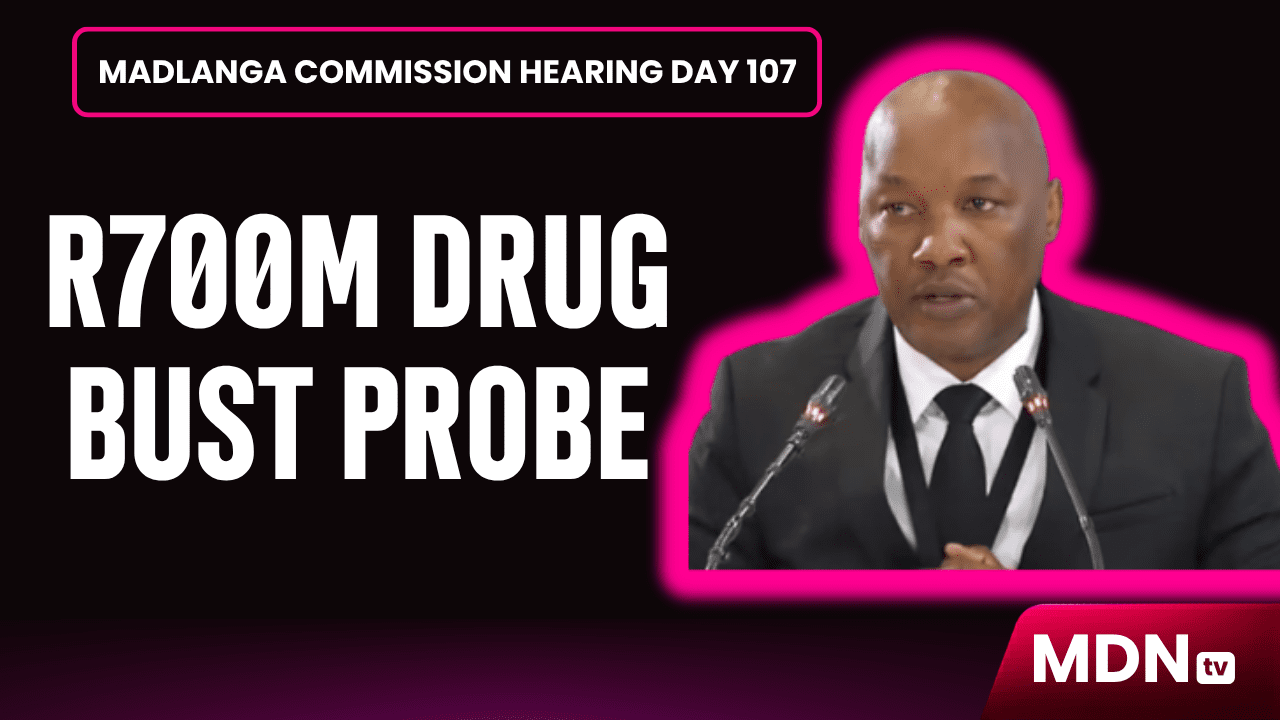
The Madlanga Commission, a significant public inquiry in South Africa, commenced on 17 September 2025. On the 107th day of proceedings, the inquiry took a dramatic turn when an experienced investigator acknowledged, under the scrutiny of the Commissioners, that his testimony was “totally untrue”.
Warrant Officer Boy Steve Phakula, who has served in the National Investigation Unit (NINU) for over 20 years, was the witness. His testimony, intended to clarify his involvement in the controversial Aeroton drug bust of July 2021, revealed serious flaws in police integrity. By the day’s end, Phakula’s reliability had been shattered, paralleling the 23 sports bags of cocaine that represented a troubling issue within the South African Police Service (SAPS).
The “Totally Untrue” Admission
The morning session showcased increasing tension between Phakula and the Chairperson. The pivotal point was a particularly damaging paragraph in Phakula’s written statement: paragraph 24, where he asserted that the crime scene was “handled in line with the SAPS National Instruction 1 of 2015”.
The Chairperson, referencing earlier witness statements that deemed the handling of the scene a “stuff-up” and “clueless,” confronted Phakula about the inconsistency in his account.
“I must admit that it is incorrect,” Phakula stammered.
Pushed further by the Chairperson: “So, your statement is entirely untrue, right?”
“Correct,” Phakula muttered.
This revelation reverberated throughout the chamber. For a senior investigator to concede to providing a “totally untrue” statement to a judicial commission signifies more than just a procedural lapse; it represents a national outrage. In response to queries about whether he was shielding his colleague, Warrant Officer Magane, Phakula remained vague, simply asserting he had no justification for his dishonesty.
The Forensic Impossibility: The Smell of Cocaine
As questioning grew more intense, the Commission scrutinized the claim that had been described as “sensory evidence” on the day of the arrest. Phakula had earlier expressed that he justified the suspects’ arrest by asserting he could “smell cocaine” from the sports bags.
His assertion was met with skepticism from evidence leaders, who had utilized the lunch break to research narcotics. They pointed out that the cocaine bricks were not simply in bags; they were sealed in layers of black plastic, canvas, and industrial plastic that would prevent moisture, effectively making them odorless to humans.
Under the detailed examination of his statements, Phakula’s claims crumbled. He ultimately admitted he had no real knowledge of what cocaine smelled like at the time of the operation.
“You have shared a series of falsehoods,” the Chairperson noted, visibly disappointed. “You do not even know how cocaine smells, and you misled Commissioner Khumalo regarding the scent.”
The Kibler Park Meeting: A Secret Encounter in a Golf 7
One of the most compelling disclosures on Day 107 was Phakula’s account of a secret meeting with Major General Khan in September 2021. In an atmosphere reminiscent of a political thriller, Phakula shared that he received a call from an intermediary requesting a meeting with the General.
The meeting took place at a Kibler Park garage, where Phakula entered the passenger side of General Khan’s “greyish VW Golf 7”. It was within this confined space that they discussed the consequences of the Aeroton operation. Phakula claimed that the General expressed confusion about why Phakula had been arrested.
The tension escalated when General Khan inquired about the ownership of the drugs.
“I told him that people said they were his,” Phakula recounted.
The General reportedly dismissed it humorously. However, the Commission raised serious concerns regarding the dangers of this interaction, noting that Phakula’s offer to connect his informants to someone he had implicated posed potential risks.
The Missing Bricks and a Career in Limbo
Further unearthing troubling aspects, Day 107 highlighted significant inconsistencies in the chain of custody. Phakula revealed discrepancies in forensic bag numbers documented at the Booysens SAPS compared to those received at the laboratory. Alarmingly, one brick of cocaine appeared in the forensic lab a full month after the bust, under circumstances that remain “unknown”.
“That information was intentionally hidden from us,” Phakula claimed, hinting that the focus on prosecuting police officers served as a distraction, allowing the “real perpetrators” to evade justice.
The impact on Phakula’s life has been profound. Although he has successfully appealed for reinstatement within the SAPS, his career remains effectively stalled. He testified that senior officials have obstructed his progress, branding the Aeroton case as a permanent blemish on his tenure. He recounted a pattern of being moved between units and being ignored by leadership, presenting the narrative of a man burdened with knowledge but voiceless until now.
Why South Africans Should Care
The developments of Day 107 underscore the complexity of tackling crime in South Africa, facing dual battles against syndicates and the corruption within law enforcement. When a senior officer openly admits to falsifying claims about fundamental procedures and misidentifying evidence, it brings into question the integrity of the entire judicial framework.
The Aeroton drug bust involved a seizure valued at R700 million. When the chain of custody is compromised and primary investigators are revealed to have made “totally untrue” assertions, the likelihood of securing convictions diminishes significantly.
Anticipation for the Next Witness
As Phakula concluded his testimony, an atmosphere of anticipation lingered in the chamber amongst unanswered queries. The shadow of Major General Khan looms large over the Commission, with the meeting in the “Golf 7” and the missing drugs hinting at conspiratorial elements extending far beyond the Aeroton warehouse.
South Africans are left pondering: who was truly responsible for those 23 bags? And what other “untrue” statements remain concealed in the documentation of the country’s high-profile investigations? With the Commission set to continue tomorrow, attention will likely turn towards the senior leaders whom Phakula suggested orchestrated events behind the scenes. The nation awaits clarity in the midst of deception.