
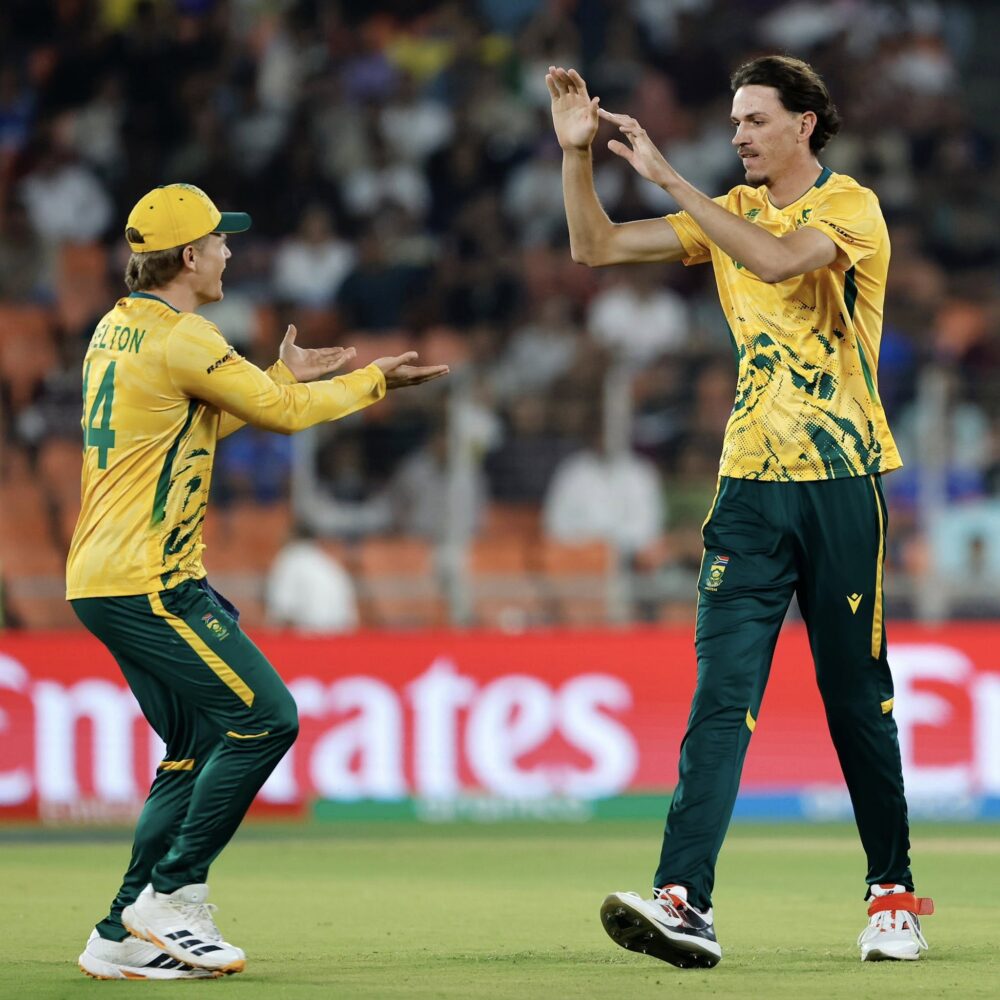
Marco Jansen celebrates taking the wicket of Rachin Ravindra during the ICC Men’s T20 World Cup in Ahmedabad, India. (Photo by Surjeet Yadav-ICC/ICC)
“It’s not a knuckle, but it’s also not a palm. It’s like out the back of the hand or deep in the hand. It’s a mixture of the two. If I go knuckle ball, you can see my knuckles above the ball and it’s easier to pick. So it’s basically my own version.”
On Saturday night, Marco Jansen, standing at the Narendra Modi Stadium, appeared more like a performer sharing a trick than a fast bowler. However, for the New Zealand batters, the experience was not amusing. Jansen’s unique slower ball was pivotal in South Africa’s convincing seven-wicket victory over the Black Caps, moving the team to the top of Group D.
Following their intense double-super-over match against Afghanistan earlier in the week, the Proteas arrived in Ahmedabad aiming for disciplined performance. They found that discipline in Jansen, who achieved his career-best figures of 4/40 and curtailed a New Zealand innings that looked ready to take off.
On a pitch described as a ‘road’, Jansen utilized his height to generate significant bounce, dismissing Tim Seifert early. His development as a bowler earned high praise from his captain. Ultimately, the Kiwi momentum fizzled out, particularly after Mark Chapman (48) was caught off Jansen’s unconventional slower ball.
“He is a very different left-arm,” said captain Aiden Markram. “To take four wickets for us tonight and keep breaking partnerships through the middle and the end is really important. The secret tonight was there was a lot of conviction beyond what they did, and that gut feel.”
This conviction led to impressive statistics. After issuing 23 wides in their previous matches, the South African bowlers demonstrated control, allowing only a single leg-bye.
Leading from the Front
If the bowlers showcased discipline, Markram provided a masterclass for the batters. His unbeaten 86 runs off 44 deliveries featured a combination of elegant strokes and powerful hits over long-on. One particular pull even drew praise from Dale Steyn, who termed it a ‘bully shot.’
Together with Quinton de Kock, who became the first South African to exceed 3,000 T20 International runs, Markram led an aggressive assault in the powerplay that effectively sealed the match well before nightfall. The Proteas raced to 83/1 after six overs, marking their highest powerplay score in a T20 World Cup.
“Ultimately, it’s about getting the team off to good starts,” Markram stated. “We’ve got a strong and experienced batting lineup. There’s a lot of power, and we need to manage it through the right phases. When it comes off like that, we feel like we’re ahead of the game.”
Efficiency Over Drama
A crucial segment of the match came in the pre-death-overs period. New Zealand stood at a comfortable 138/4 in the 14th over, targeting a score of 200. However, in the subsequent 17 deliveries, South Africa claimed three wickets while conceding just seven runs. The scoring rate fell dramatically to a mere 5.28 during the final seven overs as Lungi Ngidi and Kagiso Rabada tightened their lengths.
“I think the slow balls into the wicket worked well and then obviously the yorkers,” Jansen remarked, already shifting focus to the next challenge. “You have to change it up and adapt. I think that really worked.”
Now, the Proteas head to Delhi for their final group match against the UAE on Wednesday. While a win will solidify their top position, the Super Eight seedings indicate they will likely face cricketing giants such as India and the West Indies.
For a team often criticized for complicating their path, this match was described by Markram as “slightly easier to deal with, mentally.” It was a display of composure and skill, led by a captain who is steering a team that reflects its true potential.