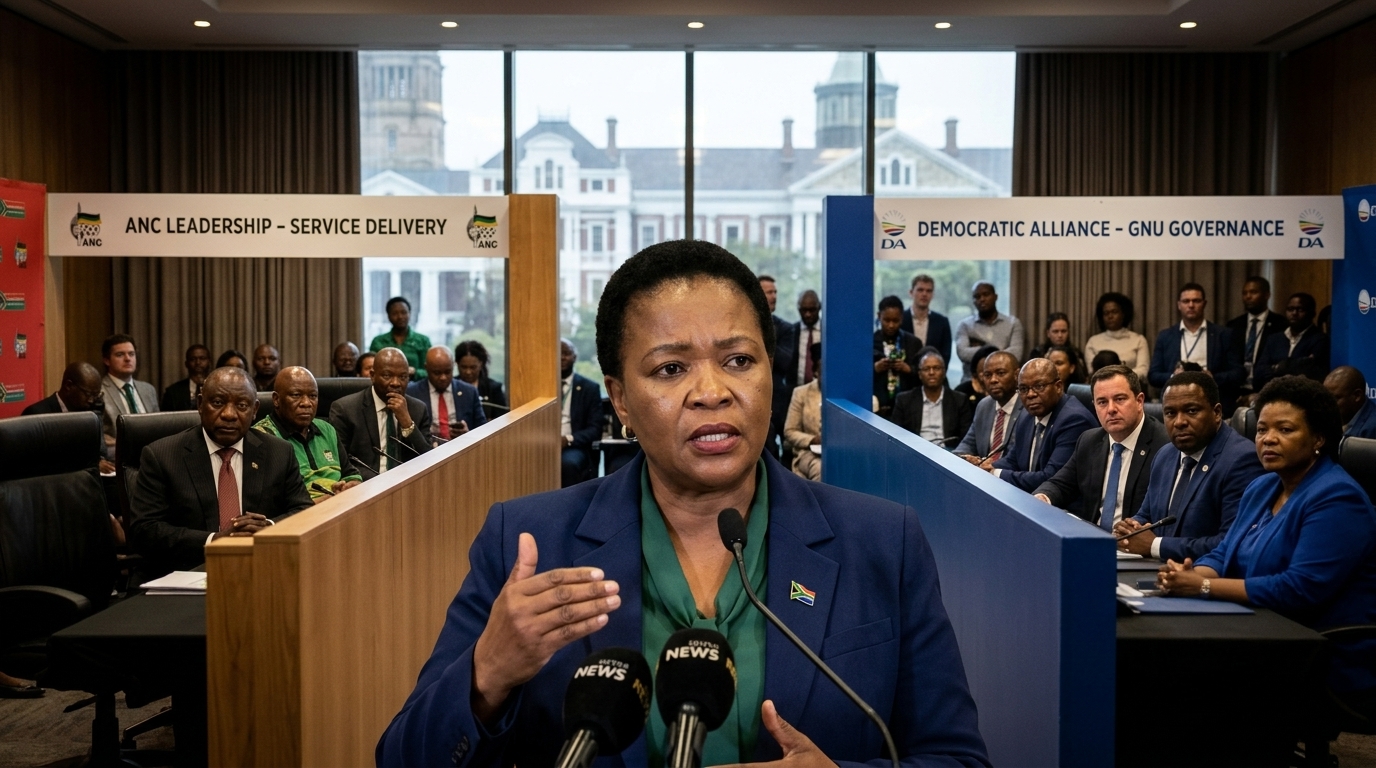
Nomvula Mokonyane, a high-ranking ANC figure, has issued a significant warning regarding the effectiveness of South Africa’s Government of National Unity. She claims that the coalition is no longer serving as a conduit for political cohesion and argues that the Democratic Alliance has largely shifted away from the foundational principles of the GNU.
Her statements come amid escalating tensions between the ANC and DA, as ongoing disagreements over governance, policy, and political strategy threaten the stability of the coalition formed after the 2024 national elections.
The GNU came into existence following the ANC’s first loss of its outright majority since 1994, necessitating collaboration with the DA and several smaller parties within the national government framework.
Mokonyane’s recent comments signal increasing dissatisfaction within the ANC regarding its partnership with the DA.
The alliance between the ANC and DA was established despite their significant ideological rifts.
From the outset, the coalition has been marked by disagreements on areas such as financial policy, transformation, foreign relations, the national budget, and the authority of ministers from both parties.
The DA has made it clear that it will not endorse ANC policies simply because it participates in the GNU.
Conversely, the ANC has sometimes accused the DA of operating more like an opposition entity than a governing partner.
Such tensions have spurred ongoing speculation about whether these leading parties can sustain cooperative governance over the long run.
Mokonyane has previously asserted that any coalition must prioritize South African interests over narrow party agendas, but her latest comments reflect a tougher stance.
The Government of National Unity was established in response to the ANC garnering just over 40% of the vote in the 2024 general elections.
This outcome marked the end of the ANC’s three-decade dominance and forced negotiations with competing political parties.
The DA, as the national second-largest party, joined the GNU along with the Inkatha Freedom Party and various other smaller entities.
Despite facing multiple political disputes, this uneasy coalition has persisted, though doubts about its durability linger.
Many of the most pronounced disagreements have revolved around fiscal and economic policies.
The DA has challenged pivotal decisions made by the ANC, even pursuing legal action on certain issues while remaining within the GNU.
These clashes raise questions about whether the GNU constitutes a legitimate collaborative government or merely an arrangement between parties with diverging political ideologies.
For the ANC, the friction with the DA also prompts strategic considerations regarding governance after losing its majority.
On the other hand, the DA faces the challenge of participating in government while maintaining its position as the leading competitor to the ANC.
The current situation does not indicate an imminent collapse of the GNU.
Mokonyane’s statements do not reflect a formal ANC decision to oust the DA from government or dissolve the GNU entirely.
Any significant reorganization of the coalition would necessitate decisions from the ANC’s established leadership and likely spark extensive political negotiations with the current government parties.
The DA has yet to declare any intent to exit the GNU.
The importance of Mokonyane’s remarks lies in the fact that a senior ANC member questions the coalition’s ability to provide the political unity for which it was originally intended.
As the GNU continues to operate, the ability of the ANC and DA to manage their differences without causing upheaval in the national government will likely shape its future.
For the ANC, the task is to retain governmental control while accommodating parties with differing policy perspectives.
The DA faces the dual challenge of being part of the government while concurrently positioning itself as a viable alternative to the ANC in the eyes of voters.
Mokonyane’s recent intervention suggests that these conflicting demands are becoming increasingly challenging to navigate.
For now, the GNU remains intact.
However, the increasingly strained language between the two primary parties indicates that the political relationship supporting it is under growing strain.