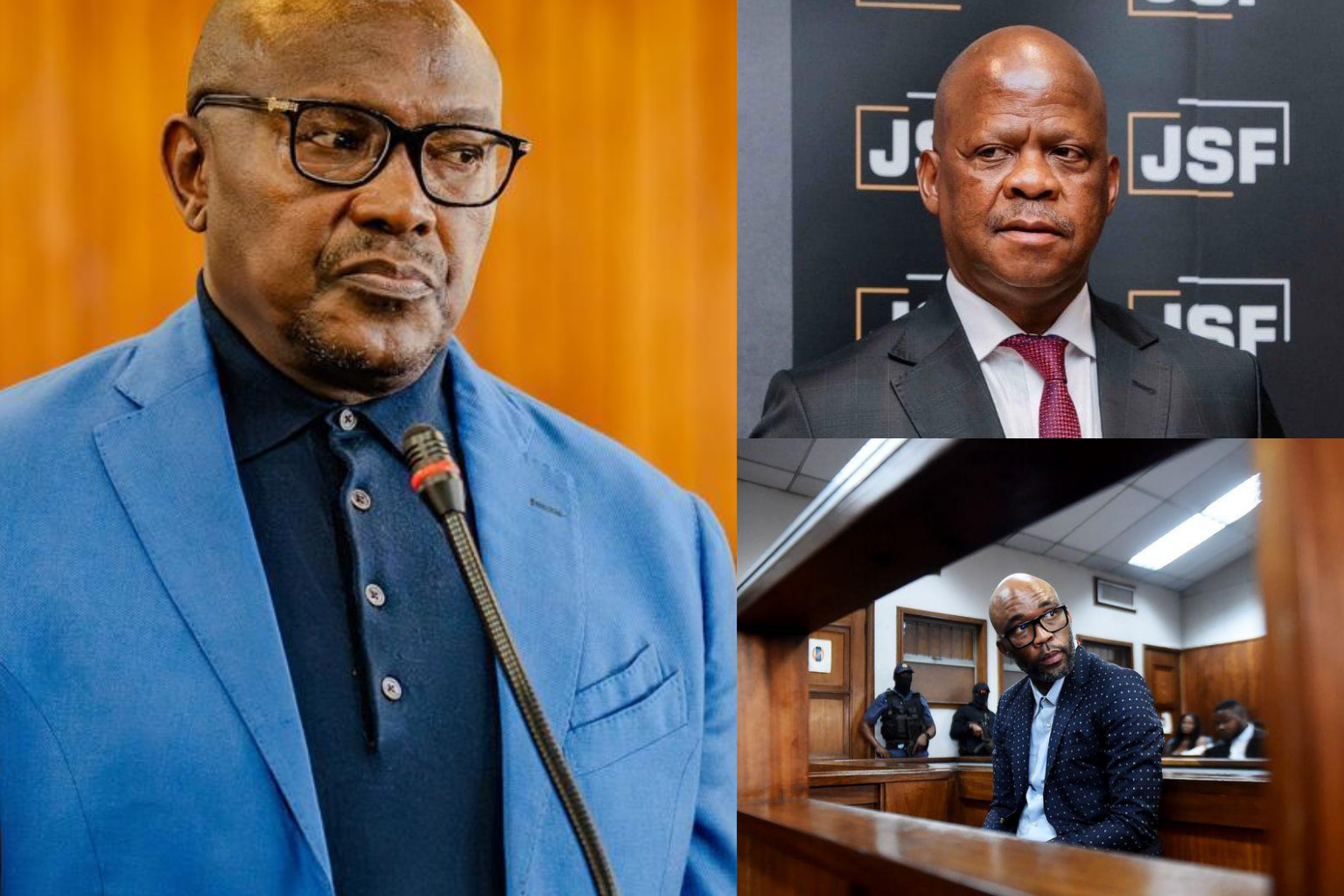
Joe “Ferrari” Sibanyoni testified dramatically before the Madlanga Commission, claiming that the presence of Vusimuzi “Cat” Matlala and Katiso Molefe around the late Mr. Msibi heightened his fears regarding a potential attack against him. The Commission pressed Sibanyoni for evidence supporting his assertions.
PRETORIA — “The game is up.”
These were the unsettling words of Joe “Ferrari” Sibanyoni as he recounted the moment he believed the threat to his safety had increased significantly.
While testifying before the Madlanga Commission, Sibanyoni named two key figures: Vusimuzi “Cat” Matlala and Katiso Molefe.
Sibanyoni indicated that his relationship with the late Mr. Msibi had seriously deteriorated by 2020.
He explained that he began deliberately distancing himself, reducing meetings, and ultimately going into hiding due to his safety concerns.
As per his account, the situation escalated from there.
SIBANYONI: “IT WAS A PROPER PLAN TO ATTACK ME”
Sibanyoni claimed that as their relationship soured, Msibi reportedly strengthened what Sibanyoni called his personal security apparatus.
He alleged that Msibi surrounded himself with individuals tied to the taxi industry, referred to as “izinkabi,” which in this context suggests hired killers.
In his testimony, Sibanyoni cited the names of Matlala and Molefe.
When asked what their presence meant to him, Sibanyoni provided a striking reply.
“From what I gathered through circumstances, it constituted a serious plan to attack me at that point,” he testified.
Sibanyoni stated he had received alarming information from visitors to the farm regarding individuals he noticed around the property.
He claimed these warnings made him increasingly aware of a developing threat.
These are allegations made by Sibanyoni under oath and have yet to be validated by the Commission.
WHY CAT MATLALA WAS A CAUSE FOR ALARM
The Commission did not take Sibanyoni’s claims at face value.
Commissioners repeatedly pressed him to clarify what he actually knew about Matlala and Molefe and why their purported connections with Msibi prompted him to feel endangered.
Sibanyoni associated his fears regarding Matlala with concerning reports of violence occurring in Mamelodi.
He explained that there were fatalities in Mamelodi, and Matlala’s name was often mentioned.
For Sibanyoni, Matlala’s alleged connections with Msibi altered his perception of the threat he faced.
“The game is up,” Sibanyoni reiterated.
Yet, the commission sought further clarification.
They inquired about the specific reasons connecting Molefe to his fears.
“SOWETO WAS ON FIRE”
In response, Sibanyoni referred to the violence erupting in Soweto.
“At that time, Soweto was on fire,” he told the Commission.
He noted numerous fatalities and mentioned Molefe’s origins in Soweto.
When asked whether Molefe’s name had surfaced in relation to instances of violence known to him, Sibanyoni confirmed that it had.
His reasoning stemmed from the information he was receiving at that time and the connections he believed existed between individuals around Msibi and the violence elsewhere.
However, the Commission continued to examine these conclusions.
COMMISSION QUESTIONS SIBANYONI’S CLAIMS
A pivotal moment occurred when Sibanyoni faced an alternative perspective.
What if, the commissioners asked, Msibi had surrounded himself with armed security due to fear of Sibanyoni rather than planning an attack?
Sibanyoni dismissed that theory.
He stated he had gone into hiding and insisted he was not being targeted himself.
He recounted that friends in the taxi industry reached out to warn him about individuals arriving to assist Msibi in Gauteng.
Others, he claimed, returned from the farm expressing that his name had been mentioned.
“Be careful,” Sibanyoni recalled being advised.
SECOND ASSASSINATION ATTEMPT DISCUSSED
The testimony then transitioned to a critical topic.
The Commission addressed the second assassination attempt against Sibanyoni.
It was confirmed that there is an ongoing criminal case related to that incident, with Sibanyoni expected to serve as a prosecution witness.
Due to the active criminal case, the Commission refrained from delving deeply into details that could affect those proceedings.
The discussion then shifted to other allegations related to the farm.
CONTROVERSIAL DRUG ALLEGATIONS UNDER SCRUTINY
Sibanyoni’s prepared statement included another serious claim.
He alleged that between 2021 and 2022, Molefe had moved what he described as criminal operations, particularly drug-related activities, to a farm owned by Msibi.
Commissioners immediately inquired about the basis of Sibanyoni’s knowledge.
His response was telling.
Sibanyoni conceded that he was not physically present at the farm during that timeframe.
He stated he depended on information from others and what he characterized as intelligence.
He also recognized the risk of relying on secondhand information, cautioning that it could be distorted.
“DID ANYONE SPECIFICALLY INFORM YOU?”
The Commission pressed further.
Sibanyoni was explicitly asked if anyone had precisely told him that Molefe was conducting drug trafficking operations from the farm.
“No, not at all,” he initially replied.
He also admitted that he had not received direct information that Cat Matlala was involved in a drug-related enterprise.
This led the commissioners to confront Sibanyoni with the language of his own statement.
His statement suggested that this information came from his own knowledge.
The Commission sought clarity: did Sibanyoni claim personal knowledge, or was it relayed from others?
Sibanyoni ultimately clarified that the information originated from another individual.
He identified the source only by relationship, stating that the individual had been a chairman at one of his associations, a close confidant who passed away from natural causes.
This distinction could play a crucial role as the Commission evaluates the credibility of Sibanyoni’s claims.
FROM FRIENDSHIP TO FEAR
Sibanyoni’s recent testimony offers deeper insights into the collapse of his relationship with Msibi.
He recounted a time when the two men collaborated closely.
However, Sibanyoni noted a shift after discussions surrounding retirement.
He testified that Msibi had previously suggested he would retire, only to later inform Sibanyoni that he was staying in the industry.
This conversation alarmed Sibanyoni, invoking memories of earlier violence in 2006/07.
He reported beginning to limit contact, avoid regular meetings, and seek to protect himself.
The COVID-19 pandemic inadvertently provided him with a buffer.
Sibanyoni explained that lockdown measures offered a valid excuse to refrain from visiting Msibi.
Beneath that rationale, however, lay a more profound reason.
Fear.
“THE GAME IS TOO UP”
The significance of Sibanyoni’s latest testimony lies not just in the high-profile individuals mentioned.
He urges the Madlanga Commission to contemplate his narrative.
He asserts he has previously survived violence.
He indicates that his association with a powerful taxi figure fell apart.
He relays that warnings started coming his way.
He observes new individuals appearing around the man he feared.
Among those identified are Cat Matlala and Katiso Molefe.
For Sibanyoni, this combination spelled trouble.
“The game is too up,” he stated.
Nevertheless, the Commission highlighted that allegations, suspicions, and information from others require scrutiny.
Sibanyoni’s assertions are not Commission findings.
Moreover, some of his gravest allegations stem from information he admitted he did not directly know.
This tension lies at the core of his explosive testimony: the harrowing account of what Sibanyoni believes was happening around him versus the Commission’s commitment to discern what can be substantiated.