 As the 2026 Local Government Elections approach, several organizations have released their final polling data, shedding light on potential voting trends.
Polling results do not guarantee outcomes and must be interpreted considering the methodologies and samples involved, but they do offer valuable insights into voter attitudes.
Historically, such data has been fairly reliable in forecasting election results.
For instance, in the 2024 National Government Election, the Social Research Foundation’s predictions exhibited a deviation of just 7 percentage points from actual outcomes.
A deviation of zero would signify accuracy, while a higher deviation indicates a less accurate prediction.
Polls conducted in 2024 frequently reported deviations exceeding 10 points, revealing the unpredictable nature of real election outcomes.
Nonetheless, polling data presents a compelling overview of voter sentiment.
Polling for Local Government Elections can be particularly complex, as national sentiments often diverge from local opinions.
Some surveys focus on the national context while delving deeper into specific municipalities.
The upcoming elections are anticipated to see a significant increase in coalition governments throughout the nation, with the African National Congress (ANC) losing its stronghold in major urban areas to smaller parties.
Particular attention is directed towards Gauteng’s economic regions, especially Johannesburg and Tshwane, which are expected to face intense competition.
Additionally, eThekwini’s political landscape will be shaped significantly by the rise of Jacob Zuma’s uMkhonto we Sizwe Party (MKP).
The following section highlights the most recent polls leading up to election day from trusted sources such as Ipsos, the SRF/The Common Sense, and MarkData/ENCA.
The figures below represent the latest polling data for these competitive municipal areas.
National poll
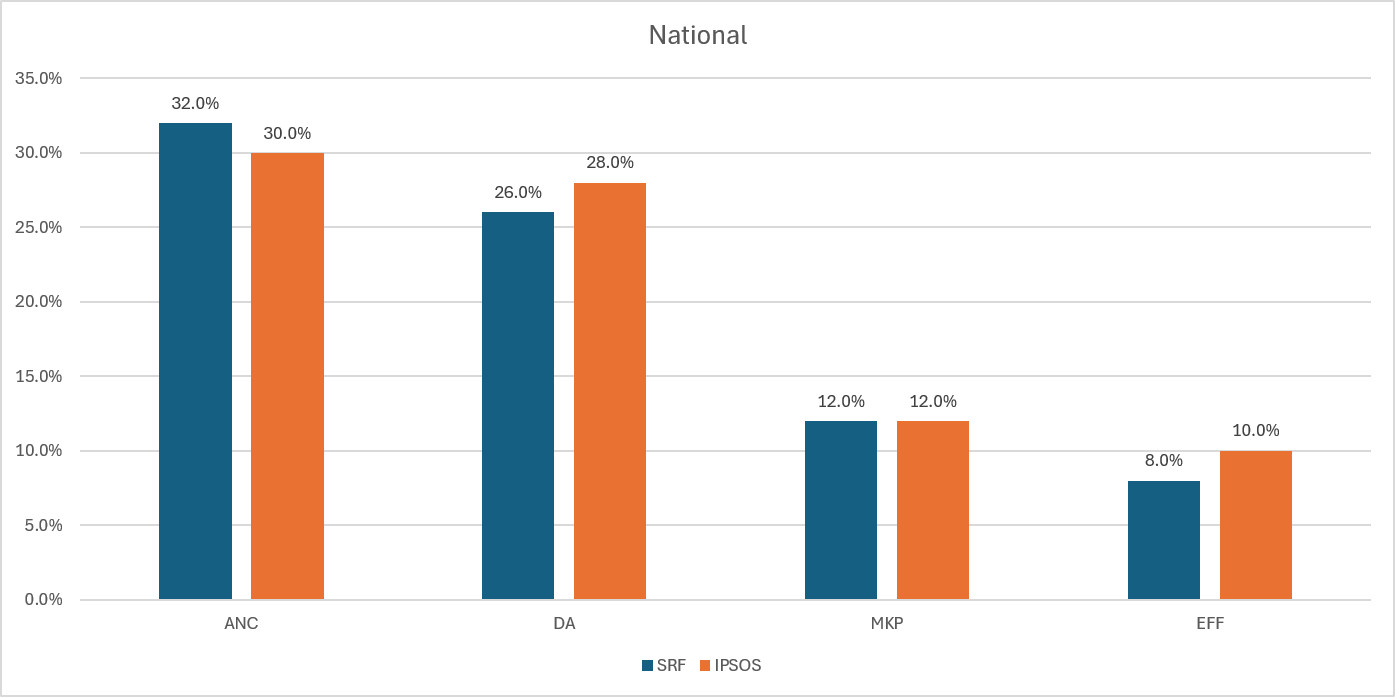
While some polls focus exclusively on local dynamics, Ipsos has also assessed national sentiments regarding the principal political parties in contention.
Reflecting the 2024 national election results, it is evident that no single party holds a dominant majority in the country, marking a decline in the ANC’s influence and the emergence of smaller parties.
The data reveals a shrinking gap between the Democratic Alliance (DA) and the ANC, a trend corroborated by SRF’s findings. Overall, the electoral landscape has not shifted significantly since 2024.
According to Ipsos, coalition governance is projected to continue defining South Africa’s political arena leading up to the subsequent National Election.
Johannesburg
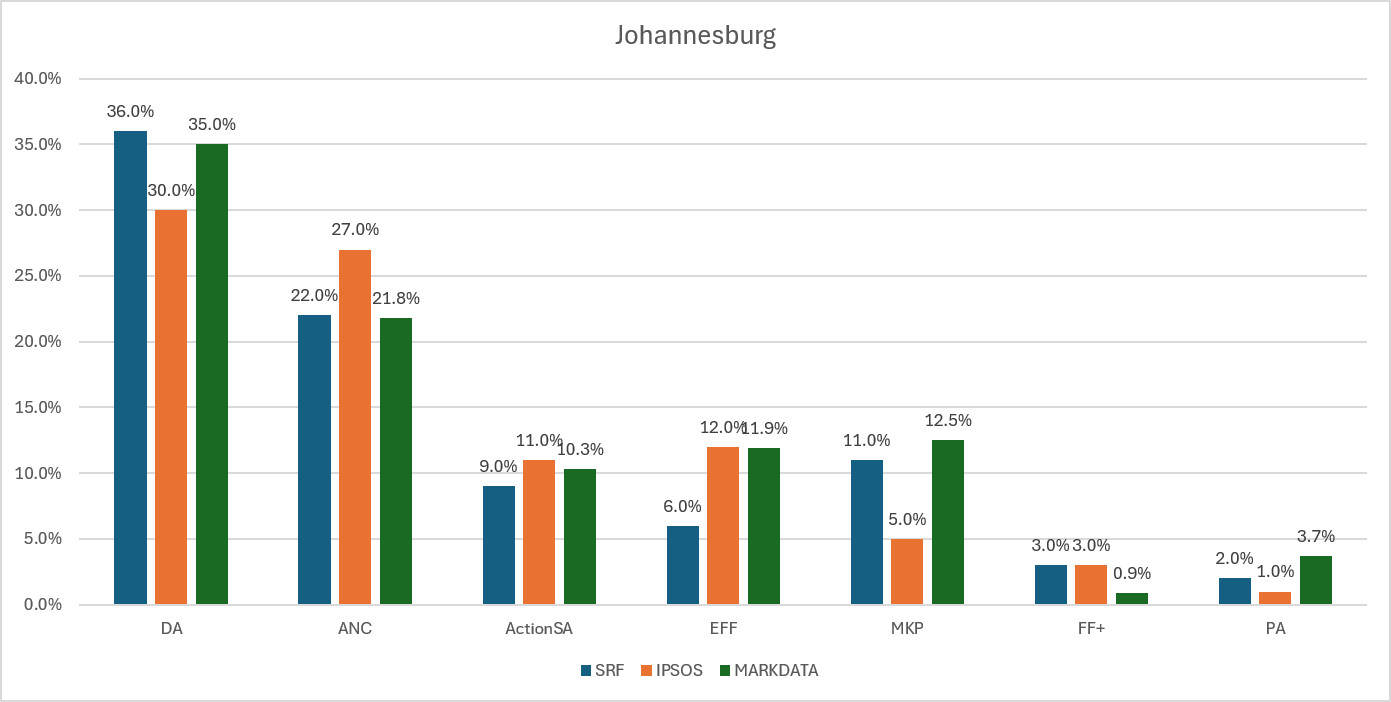
Johannesburg is emerging as one of the most competitive metros in the country, with current polling suggesting no definitive frontrunner.
All surveys indicate that the DA is in the lead, but it is well short of the 51% majority it seeks.
With numerous smaller parties in contention, a return to unstable coalition governance appears likely, mirroring the tumultuous patterns that have marked the city’s recent political history.
Tshwane
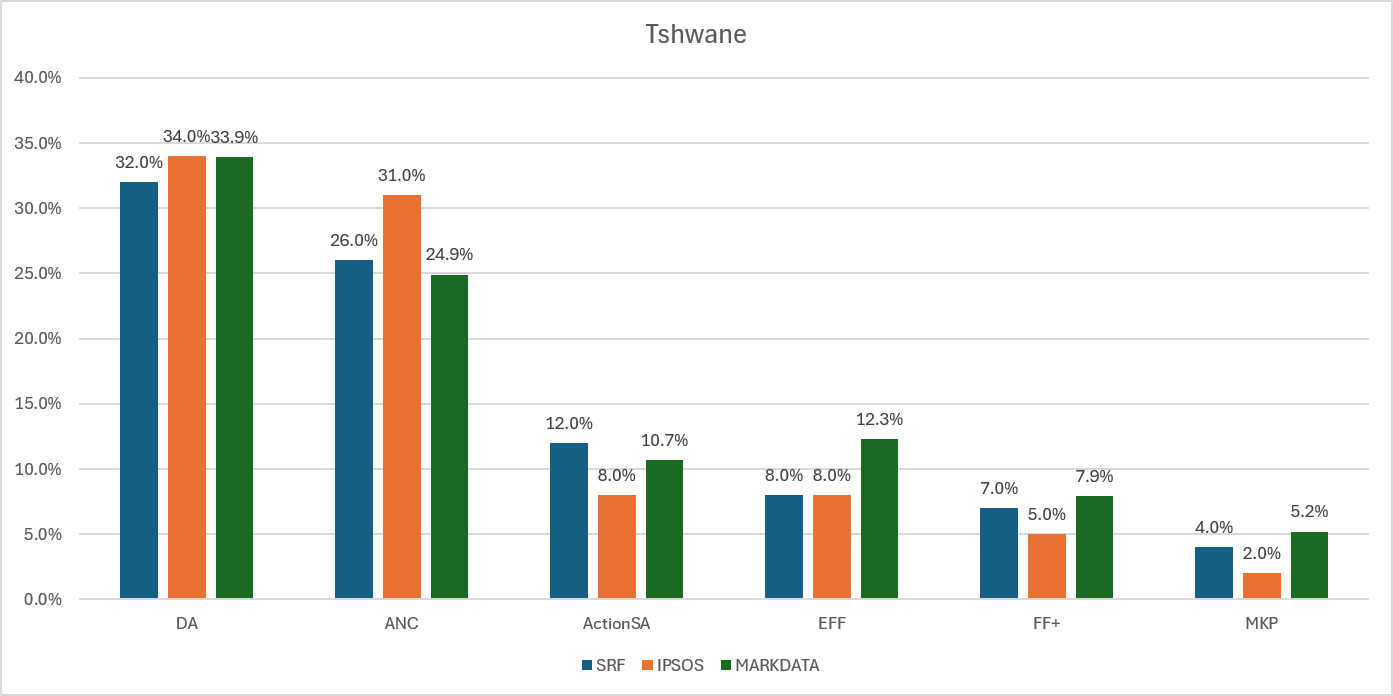
In Tshwane, similar to Johannesburg, the DA is perceived to be leading, yet the outcome is not firmly established.
The Ipsos poll reveals a competitive landscape with the ANC and DA closely matched, indicating that coalition arrangements are probable.
This scenario may once more leave the metro vulnerable to influence from smaller parties, including ActionSA, the Economic Freedom Fighters (EFF), and the Freedom Front Plus (FF+).
Ethekwini
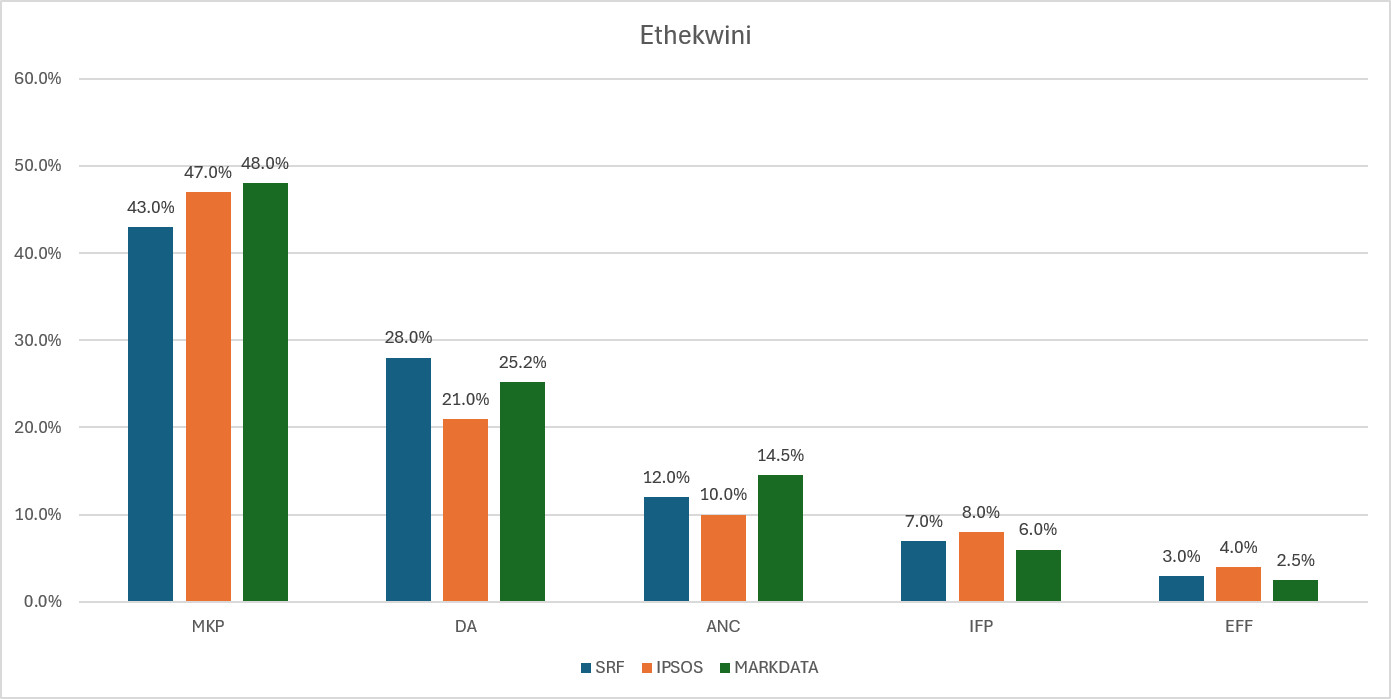
In eThekwini, the MKP has emerged as a notable favorite in the polls, significantly ahead of the DA.
Similar to trends seen in the 2024 elections, support for the MKP appears to be drawn largely from disillusionment with the ANC, pushing them into third place behind the DA.
The Inkatha Freedom Party (IFP) and EFF remain the other significant contenders in these surveys.
Who ran the polls
| Poller | Who | Sample | 2024 National Election accuracy |
|---|---|---|---|
| Ipsos | Ipsos is a leading global market research firm, active in various polling since 1975. It operates as a publicly traded multinational. | Interviews with 3,600 randomly selected South African adults, conducted between 12 September and 13 October 2026. Registered voters. Non-voters were excluded from the sample. | 12.0 point deviation |
| SRF/Common Sense | Established in 2021, the SRF is a think tank in South Africa focused on promoting democracy and effective public policies, chaired by analyst Dr. Frans Cronje. It is privately funded. | Surveys conducted by SRF/TCS through Victory Research from 18 September to 12 October 2026 among 3,100 respondents, weighted to reflect registered voter demographics. | 7.0 point deviation |
| MarkData/ENCA | MarkData is an independent firm specializing in marketing insights and research, originally part of the Human Sciences Research Council, re-established as a private entity in 1996. ENCA is a 24-hour news channel owned by eMedia Holdings. | A survey conducted by MarkData involving 6,113 voters from six major metros, averaging about 1,000 people per metro, held between 10 August and 14 September 2026. | 10.6 point deviation |