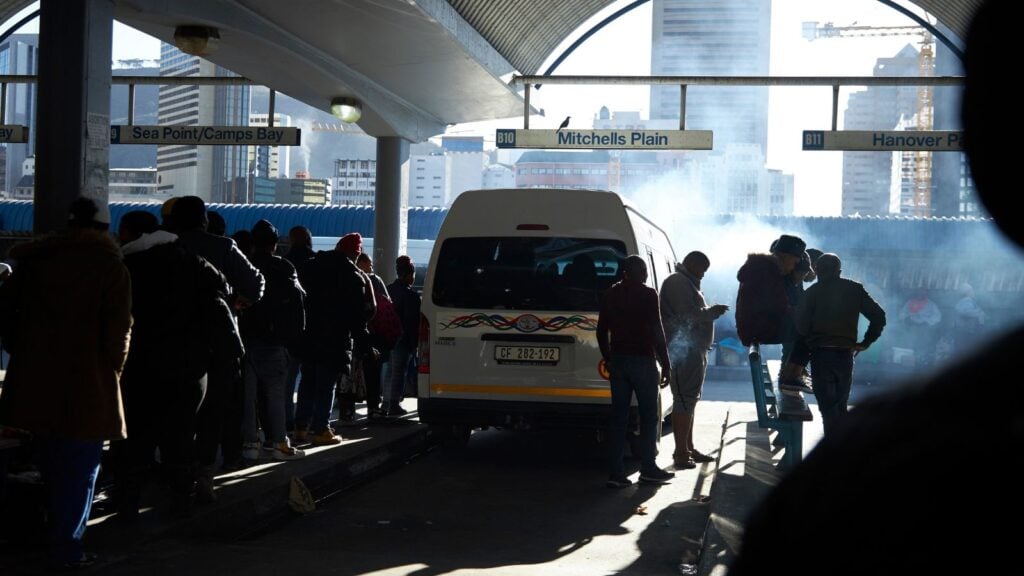
In South Africa, drivers of minibus taxis generally earn between R250 and R400 each day, amounting to R5,000 to R8,000 monthly, though those on high-demand routes may earn significantly more.
Job aggregator Indeed reported that the average monthly salary for taxi drivers in South Africa reached R6,369 in 2026.
Nonetheless, earnings vary widely. Some drivers report monthly incomes as low as R4,800, while those servicing profitable routes in major urban areas can exceed R15,000.
Factors influencing driver earnings include the number of passengers, the profitability of their routes, fuel expenses, and agreements with vehicle owners.
The majority of minibus taxi drivers do not own their vehicles. Instead, they work for owners, who are often connected to local taxi associations.
These associations oversee route access and manage how territories are allocated.
National representation for the industry comes from groups like the South African National Taxi Council (SANTACO) and the National Taxi Alliance.
Many employment arrangements in this sector are informal, relying on verbal agreements rather than official contracts.
Drivers typically must meet daily or weekly revenue targets for the vehicle owners, retaining any earnings above that threshold.
For instance, a driver may be tasked with raising R600 daily or R4,000 weekly, with their actual income dependent on the amount collected beyond the required target.
Operating expenses also vary among drivers.
Some are responsible for their own fuel costs, while others have them covered by the vehicle owners, who might also handle maintenance expenses.
This variability complicates efforts to accurately assess overall earnings in the taxi driving profession, as much revenue is transacted in cash without formalized employment documentation.
The minibus taxi sector is the largest public transport segment in South Africa, facilitating roughly 60% to 70% of daily commuter trips.
Annual revenues are estimated between R90 billion and R100 billion, supporting over 600,000 direct and indirect jobs.
Data from The Outlier, based on the South African Reserve Bank’s (SARB) 2026 Cost of Cash Study, highlights that 98.5% of minibus taxi riders pay using cash.
SARS is closing in on the taxi industry

The country has around 130,000 registered minibus taxis, with SANTACO suggesting the actual count could be over 200,000 when accounting for unregistered operators.
Despite the sector’s economic significance, concerns persist regarding working conditions, compliance with labor laws, and overall regulatory frameworks.
Taxis and their drivers are subject to South African labor regulations, including minimum wages, working hour limits, and overtime rules.
However, enforcement remains challenging due to the prevalence of informal work agreements in this sector.
The demand for daily revenue has also been associated with hazardous driving behaviors, such as overloading vehicles and speeding to maximize trips.
Additionally, the high revenue turnover in the industry has attracted scrutiny regarding tax contributions.
In March 2025, Organisation Undoing Tax Abuse (Outa) CEO Wayne Duvenage noted that formalizing the industry could enhance South Africa’s tax base.
“It’s not to punish the taxi industry. It’s to say you are formalised, you are businesses, you need to be brought into the net,” he stated.
His remarks were in response to a 2021 parliamentary report that indicated the entire minibus taxi sector contributed about R5 million in tax.
The Democratic Alliance (DA) contended that many operators are not reporting corporate income or remitting payroll taxes for workers.
However, SANTACO disputes claims that the industry largely evades tax obligations, emphasizing that many operate as sole proprietors and are taxed at individual rates.
SANTACO spokesperson Mmatshikhidi Rebecca Phala informed The Star that those operators obtain tax clearance certificates from the South African Revenue Service (SARS), necessary for applying for or renewing operating licenses.
“The taxi industry, in the main, is comprised of operators who run their businesses as sole proprietors,” she remarked.
Phala further noted that the current tax structure does not adequately reflect the industry’s makeup, suggesting a need for reform.
Finance Minister Enoch Godongwana has indicated that SARS is striving to boost compliance within the informal economy, including the taxi sector.
“SARS continues to broaden the tax base by improving registration, filing and payment, where tax compliance remains low. This includes the informal economy and the taxi industry,” he said.