
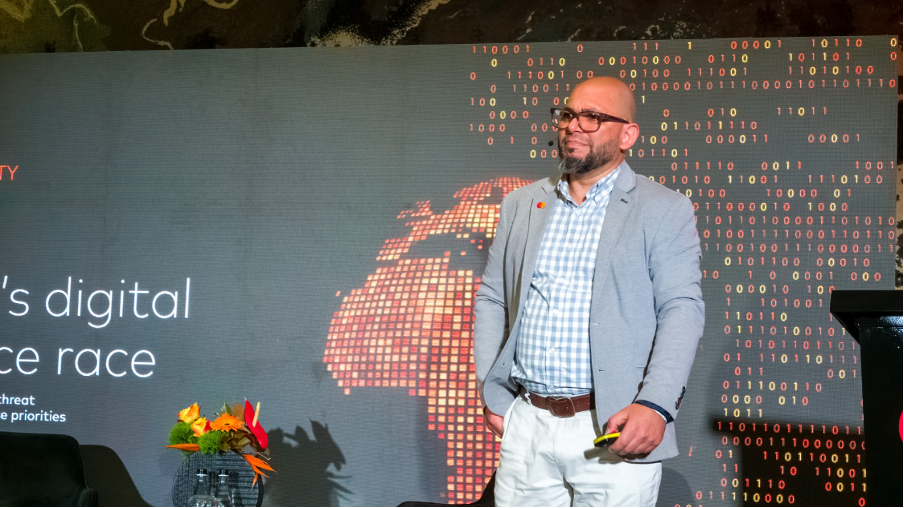
South Africa ranks among the most technologically advanced economies in Africa, supported by a robust banking sector and a growing digital environment.
With projections indicating that the continent’s total digital economy could reach $1.5 trillion by 2030, there are significant opportunities for both businesses and consumers.
This perspective was shared by Shabir Ahmed, who serves as Mastercard’s Senior Vice President and Customer Solutions Centre Lead for Africa.
Ahem made these remarks during the launch of Mastercard’s Africa Cybersecurity Whitepaper held at The Leonardo in Johannesburg.
He noted that the advancement of South Africa’s digital economy has heightened the necessity for strong cybersecurity measures.
Mastercard’s Africa Cybersecurity Whitepaper reveals that South Africa’s digital progress makes it particularly vulnerable to cyber threats.
The country’s position as one of the most digitally progressive on the continent, combined with its established banking system, leads to higher risk levels compared to other nations.
While countries like Nigeria, Morocco, and Kenya experience their own unique cyber threats—for instance, Kenya for its mobile payment systems and Morocco for its role as a digital bridge between Africa and Europe—South Africa faces distinct challenges.
Mobile banking and digital finance have surged in South Africa. The nation’s well-developed banking sector features a mature card ecosystem, and innovations such as PayShap have broadened access to financial services.
Consequently, e-commerce has become integral to the economy.
As these digital environments expand, they become more attractive to malicious actors.
The sectors of technology, public services, and financial services have been responsible for 44% of recorded cyberattacks, underscoring the value of the data and systems they manage.
Small and medium-sized enterprises (SMEs) are also identified as vulnerable targets, comprising roughly 95% of registered businesses across Africa and accounting for about half of the continent’s GDP.
However, SMEs typically allocate around $23 per employee towards cybersecurity, a stark contrast to the approximately $189 spent per employee by larger firms.
This disparity is alarming, as an attack on an SME could potentially devastate the organization, while larger companies often recover due to their size and resources.

Shabir Ahmed, Mastercard’s Senior Vice President and Customer Solutions Centre Lead for Africa
The whitepaper also noted an alarming rise in cyberattacks across Africa, showing a 421% increase from 2016 to 2025, alongside a shortfall of 200,000 cybersecurity experts and escalating demands on organizations to safeguard their digital systems.
On a positive note, the study indicates that African fintech companies have increased their cybersecurity budgets significantly, raising their investment from 3-5% of operational budgets to between 8-12%.
This shift demonstrates that African businesses are becoming more proactive about investing in cyber resilience.
“At Mastercard, we understand that cybersecurity is no longer just a technology concern; it needs to be regarded as a crucial driver for economic development,” said Ahmed.
“Establishing robust cyber resistance and solid programs for cyber resilience can create important growth avenues and secure investment for emerging digital economies.”
Ahmed participated in a fireside discussion alongside Yazad Darasha, CEO of White Paper Media, focusing on the whitepaper’s findings.
Darasha explained that the research amalgamated Mastercard’s proprietary cybersecurity insights with economic performance metrics, sector data, law enforcement inputs, and dialogues with leaders in corporations and government.

Matanda and Ahmed are joined by Yazad Darasha, the CEO of White Paper Media, for a fireside discussion about the whitepaper
The data presented a consistent theme: as economies grow, the cyber threats they face also tend to increase.
Darasha concluded that the sectors most severely affected include telecommunications, mobile money, financial services, and governmental operations.
This analysis illustrates the connection between economic growth, digital transformation, and the rise of cyber threats.
Ahmed emphasized the importance of collaboration and skill development to help African organizations keep up with the increasingly sophisticated nature of cyber threats.
Click here to download the whitepaper.

Don’t miss the latest news