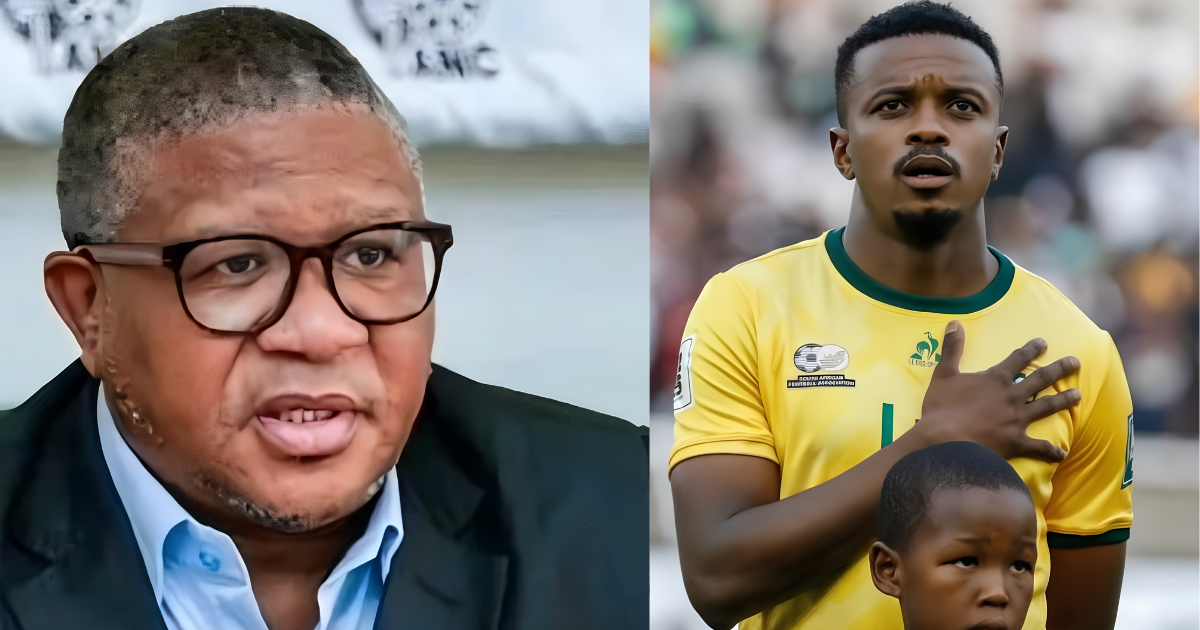
Fikile Mbalula, the Secretary-General of the ANC, has responded to comments made by Dr. Nkosazana Dlamini-Zuma, emphasizing that public figures should not make unfounded allegations against others and should expect those accused to respond.
Mbalula also highlighted the increasing significance of podcasts in the political landscape of South Africa, asserting that the hosts of these shows should not be held accountable for controversial remarks made by politicians who choose to appear on their platforms.
Addressing Dlamini-Zuma’s comments, Mbalula recognized her right to voice her opinions publicly.
“We can still argue that Mam Nkosazana has a right to express her views in public, but engaging these podcasts and expressing views must not be to denigrate others without substance,” Mbalula said.
His remarks focused on the risks associated with making serious accusations without providing supporting evidence.
“The issue is attacking the person with unsubstantiated claims. We can’t just accuse people with no substance and expect them not to take action,” he said.
Mbalula acknowledges concerns over money in politics
Mbalula stated that the issue of money’s influence in politics is a valid topic of discussion.
“We are grappling, all of us, with the phenomenon of money in politics and the dangers of that,” he said.
He emphasized that addressing the impact of money is crucial for the ANC in light of its self-identification as a revolutionary party.
“Dealing with that is important in a party such as the ANC that refers to itself as a revolutionary party,” he said.
Nevertheless, he argued that legitimate discussions about financial influence should not devolve into baseless accusations against specific individuals.
Mbalula cites Derek Hanekom’s action against Zuma
Mbalula referred to the legal case involving Derek Hanekom, a former ANC leader, and Jacob Zuma to underscore the reasons individuals may resort to legal action when faced with serious accusations.
Hanekom initiated legal proceedings after being labeled an “enemy agent” by Zuma.
Mbalula contended that Hanekom could not ignore such grave allegations and seek resolution solely through political channels.
“He couldn’t fold his arms and say he will deal with it politically,” Mbalula said.
“If he didn’t take the legal route, today people would be calling him an impimpi, an informer, and a sellout. It would be a statement of fact.”
This case illustrates why those who feel wrongfully accused are not likely to stay silent.
‘Elders must be elders’
Mbalula also spoke about the responsibilities of senior members within the ANC, conveying a clear message regarding their obligation within the organization.
“Elders must be elders,” he said.
He remarked that experienced ANC members play a crucial role in offering political guidance, but should approach this duty with care.
“Elders have a role in the ANC and they must exercise that role cautiously, meticulously and give guidance,” he said.
Despite his differences with Dlamini-Zuma, Mbalula recognized her significant historical contributions to the ANC.
“As much as we can call ourselves leaders, we cannot match the historical contributions of leaders such as Nkosazana,” Mbalula said.
He emphasized that the stature of veteran leaders imposes additional responsibilities when they engage in public political discussions.
“With that responsibility they have, they must engage honestly,” he said.
Mbalula defends Ndlozi’s African Renaissance podcast
Mbalula leveraged the conflict to advocate for podcasts and their rising role in South African political dialogue.
“All podcasts are important. They are mushrooming everywhere and each is unique in what they are talking about,” he said.
He notably commended Mbuyiseni Ndlozi’s African Renaissance podcast for facilitating discussions on political and social matters.
“Ndlozi’s podcast is important because it brings people who debate issues and we appreciate that,” Mbalula said.
Mbalula rejected any notion that podcasts should bear the blame for the statements made by guest politicians.
“The fact that ANC leaders go there and say whatever they want, we can’t blame the podcast presenter for that. They are simply doing their job,” he said.
He asserted that there was no ulterior motive behind the podcast concerning the ongoing dispute.
Mbalula’s comments bring renewed scrutiny to the evolving role of podcasts in South African politics, as politicians increasingly use these digital platforms to address party issues and broader topics beyond conventional media formats.
He maintained that the ultimate responsibility for statements made on these platforms lies with the politicians themselves, rather than the hosts who provide the venue for discussion.