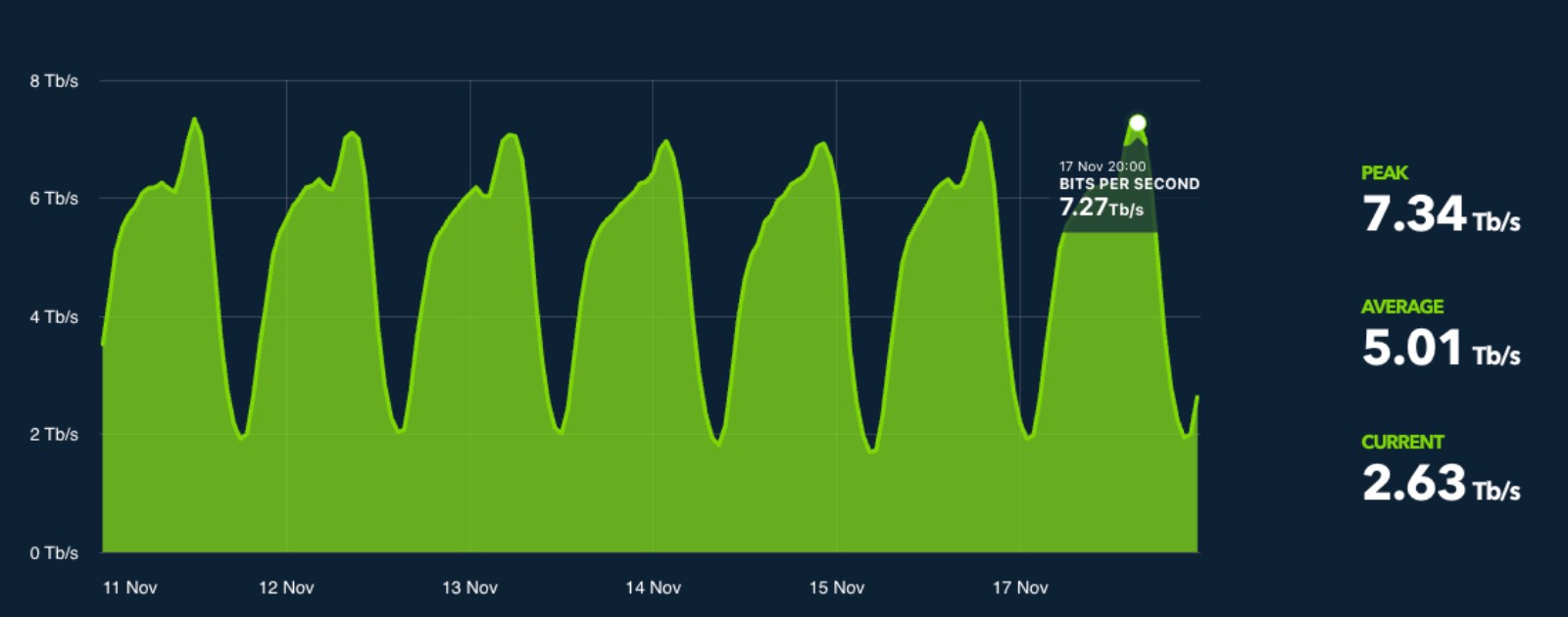
On Wednesday, Teraco reported that its NAPAfrica Internet exchange point (IXP) has achieved a significant milestone, reaching 7Tbps in traffic. This growth is attributed to the expanding peering community.
NAPAfrica now connects over 690 networks and has announced new investments in 800G ports to enhance capacity for its members.
“NAPAfrica traffic has grown to more than 7Tbps of peak traffic presently, from 6Tbps a year ago, driven by content delivery networks and cloud operators investing in new infrastructure in Africa,” Teraco stated.
“The larger 800G ports provide NAPAfrica members with increased capacity into the exchange and the wider ecosystem.”
Andrew Owens, Teraco’s interconnection and peering lead, mentioned that the demand from content delivery networks and cloud service providers has prompted the need for larger port capacities to manage increased traffic.
“We are investing in this infrastructure so we can continue to grow alongside the community,” Owens said.
Teraco’s ecosystem consists of more than 29,500 interconnects, with links to 285 network providers and network connections throughout 25 Southern African nations.
“Interconnection and peering enable enterprises to connect directly to cloud on-ramps at a Teraco data centre,” the company noted.
These enterprises include major players such as Microsoft Azure, Alibaba Cloud, Amazon Web Services, Google Cloud Platform, Huawei Cloud, Oracle Cloud Infrastructure, and Zadara.
“Connecting inside a Teraco facility reduces the risk of fibre breaks, removes additional network costs, and improves latency and service level agreements,” Teraco emphasized.
“Teraco’s facilities provide clients with direct interconnect access to the subsea cables landing in South Africa, including 2Africa, ACE, EASSy, Equiano, METISS, SACS, SAT3/SAFE, Seacom, and WACS.”
The company also supports connectivity nodes for all low Earth orbit satellite operators servicing Southern Africa.
“Subsea capacity is improving connectivity across the continent. With more carriers and cables arriving, networks and enterprises can easily reach global content, clouds, and markets,” Owens remarked.
Teraco indicated that the financial sector’s interconnection and peering demand has also been on the rise, as this sector needs resilient and low-latency access to networks, clouds, and ecosystem participants.
“For financial markets, connectivity and latency are what matter most. As more enterprises join, they need direct connections to the largest global cloud, Internet, and content companies,” Owens said.
“These companies are already inside our facilities. For Teraco, the priority remains to provide resilient, neutral, and scalable infrastructure that allows communities to continue developing.”
NAPAfrica Traffic Chart: 11 to 18 November 2026

Don’t miss the latest news