The unfair dismissal claims made by former employees of the South African Post Office (SAPO) have been suspended due to the discovery that a ruling from the Commission for Conciliation, Mediation & Arbitration (CCMA) was based on fabricated legal precedents.
The CCMA, an independent body in South Africa, aims to resolve conflicts between employers and employees effectively and reasonably, thus minimizing the need for costly court proceedings.
On 23 October, Acting Labour Court Judge Sean Snyman criticized CCMA Commissioner Menzi Fakude for allegedly relying on AI-generated content to rule against SAPO.
This incident illustrates what Snyman referred to as the “scourge” of artificial intelligence insidiously entering the South African legal framework as large language model chatbots become more widely utilized.
The case involved six former employees who were dismissed on 2 December 2025 for alleged misconduct and who sought to have their jobs reinstated along with back pay through the CCMA.
In representing the dismissed employees, Commissioner Fakude faced the challenge of circumventing a legal moratorium on unfair dismissal claims against SAPO, as stipulated by South Africa’s Companies Act.
Under this legislation, once a company enters business rescue, no unfair dismissal actions can be initiated unless permitted by the High Court or agreed upon by the company’s business rescue practitioners.
SAPO entered business rescue in 2023, two years prior to the dismissals. Despite the entity’s application to exit business rescue, that request remains under consideration.
To advance the claim for the employees, Fakude employed various legal arguments to contest the business rescue moratorium and initiate arbitration regarding their dismissals.
He referenced a case purportedly titled “South African Post Office SOC Ltd (In Business Rescue) and Others v Communication Workers Union and Others [2023] ZACC 40” as a foundation for his reasoning.
By citing this supposed judgment, he concluded that “business rescue does not suspend the operation of labour legislation or deprive employees of access to the statutory dispute-resolution mechanisms.”
However, SAPO contended that this judgment did not exist, a point underscored in its legal submission to the Labour Court.
“An untenable state of affairs and a complete failure”

“In fact, the citation of ‘2023 ZACC 40’ belongs to a judgment of the Constitutional Court in Rayment and Others v Minister of Home Affairs and Others,” said Snyman.
“The case has nothing to do with business rescue and the rights of employees under the LRA with reference thereto. The judgment concerned the Immigration Act.”
Snyman recounted searching the entire SAFLII database for the case law purportedly cited by the CCMA. Although he found related rulings, all were from before SAPO entered business rescue.
“It appears that Commissioner Fakude must have relied on AI in seeking to find substantiation for his reasoning,” Snyman stated.
“That AI, based on the instructions provided, would then come up with the reasoning and reference to the authority then directly relied on by him.”
Snyman further criticized Fakude, the first respondent in SAPO’s legal application, remarking that he clearly failed to verify whether the cited case was “even remotely correct.”
“This is an untenable state of affairs and a complete failure on the part of the first respondent to lawfully and with the expected diligence and responsibility, discharge his duties as an arbitrator,” Snyman declared.
CCMA restrained from proceeding with arbitration against Post Office

AI language models are susceptible to generating false information that may seem quite credible, a phenomenon known as AI hallucination.
A global database on court cases involving AI hallucination, compiled by legal scholar Damien Charlotin, indicates that six such instances have occurred in South Africa.
The initial domestic incident, which transpired in the Johannesburg Regional Magistrate’s Court in 2023, resulted in leniency for the involved attorneys.
Due to the limited understanding of large language models at that time, the Court utilized the situation to caution legal practitioners in South Africa.
Subsequent cases were met with more stringent responses, leading to offenders being reported to the Legal Practice Council for potential disciplinary measures.
In the recent ruling by the Labour Court, Snyman referred to UK legal standards regarding practitioners’ obligation to verify data when utilizing AI for legal research.
“The [AI] responses may make confident assertions that are simply untrue. They may cite sources that do not exist,” Snyman quoted from a judgment in the UK.
“Those who use artificial intelligence to conduct legal research, notwithstanding these risks, have a professional duty to check the accuracy of such research by reference to authoritative sources.”
The Labour Court has issued an injunction, preventing the CCMA and Fakude from continuing with the arbitration related to this dispute.
“The arbitration proceedings under CCMA case number FSWK 2876-25, scheduled for 15 October 2026, are stayed,” Snyman ruled.
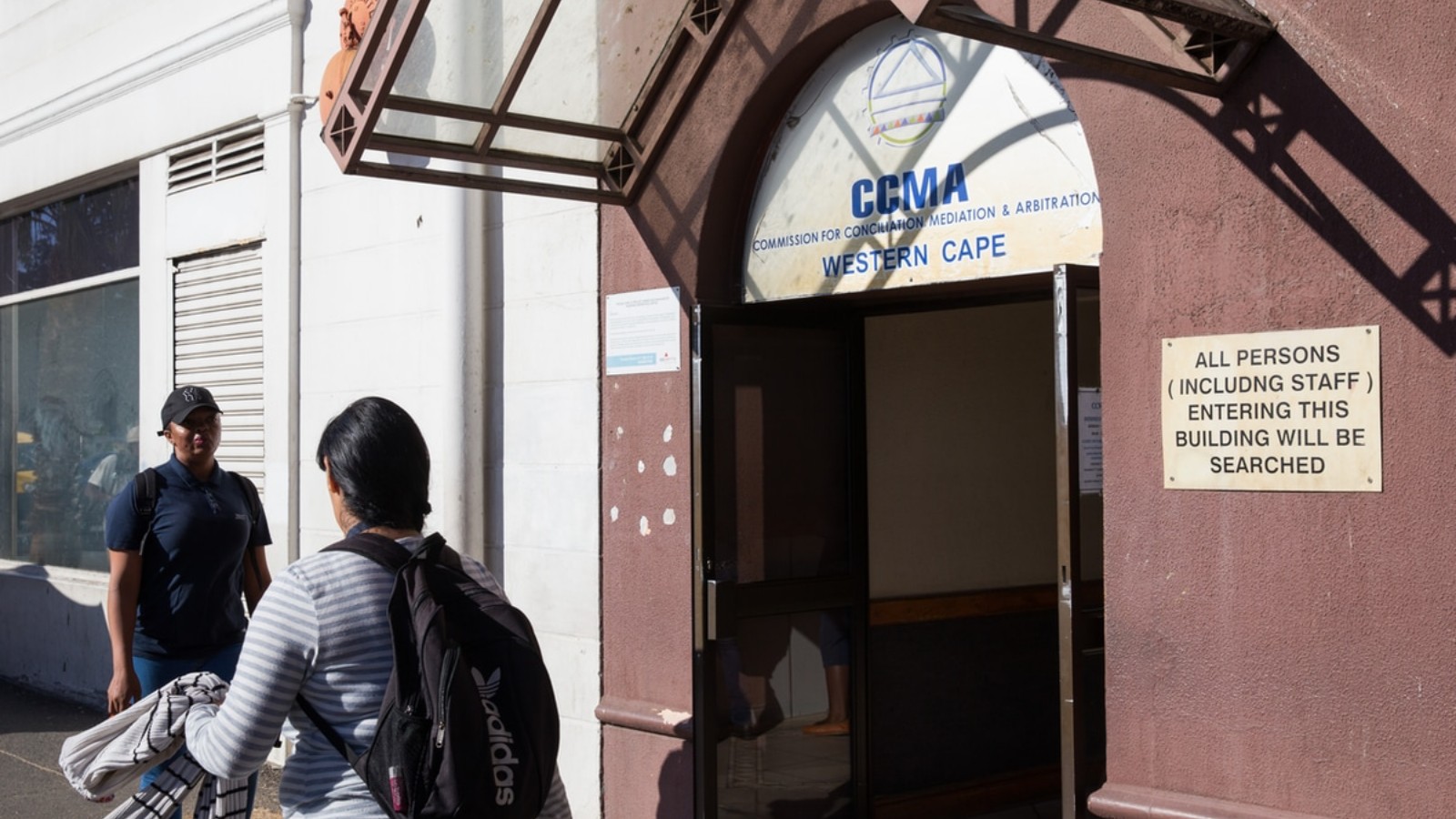
Article thumbnail: Labour Court of South Africa. Photographed by Ashraf Hendricks/GroundUp.
Don’t miss the latest news