
 The South African bond market saw an uptick as the government announced a reduction in weekly bond issuance and Finance Minister Enoch Godongwana introduced new fiscal measures aimed at ensuring debt stability.
Godongwana highlighted that national debt as a proportion of gross domestic product reached 78.4% in the 2025-26 fiscal year, a figure slightly lower than earlier projections made in February, and it is expected to decline moving forward.
“South Africa has emerged from the fiscal wilderness,” he stated during his presentation of the medium-term budget policy statement in Cape Town on Wednesday.
“Government is meeting its fiscal targets and restoring the public finances to good health.”
The yield on South Africa’s 10-year government bonds dropped by 12 basis points to 8.84%, marking its lowest point in over a month. By 2:45 p.m. in Johannesburg, the rand had strengthened slightly, trading at 16.37 to the dollar.
“Treasury has cut weekly issuance by far more than the market expected, thanks to strong revenues and a change in the funding mix, and it has also included bond buybacks,” noted Adam Furlan, a portfolio manager at Ninety One SA.
“All in all, this is a good, bond-friendly budget. It confirms that debt-to-GDP has peaked and will fall gradually, and rating agencies should receive it well.”
The consolidated budget deficit is projected to decrease to 3.9% for the year ending in March, down from a previous forecast of 4%.
The Treasury also anticipates a growth in the primary budget surplus, which measures revenue minus non-interest expenditures, for the fourth consecutive year, rising to 1.7% of GDP from 1% in 2025-26.
To secure these improvements, draft legislation for fiscal anchors was proposed for public input, which Godongwana indicated would be presented to parliament next year.
This legislation aims to establish a principles-based fiscal rule centered on sustainability, requiring each new administration to define targets that will be subject to parliamentary oversight.
“The fiscal anchor forms part of the most extensive reconfiguration of the public finance system since 1999, in line with broader efforts to strengthen state capability,” the National Treasury indicated in its budget documentation.
A strong performance
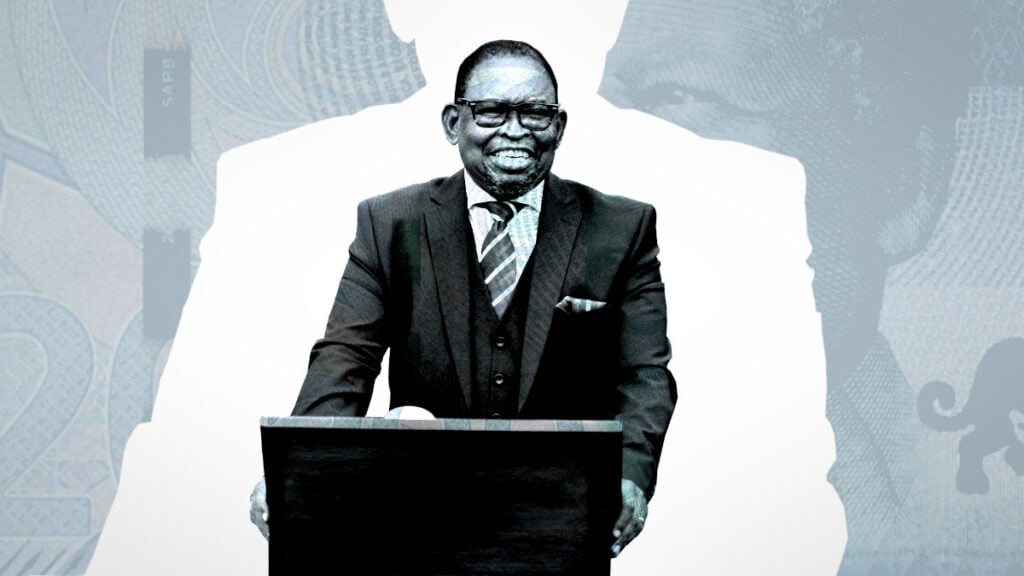
 Finance Minister Enoch Godongwana.
This financial restructuring may enhance market confidence. South African bonds have shown better performance than comparable instruments in recent months.
“Markets will be encouraged to see South Africa with a stronger balance sheet and a firm grip on debt,” commented Karim Noujaim, Founder and Managing Director of Skykapital.
“The country’s investment case is stronger than it has been for some time.”
The Treasury projects additional tax revenue of R17.1 billion compared to expectations outlined in February, aided by better-than-expected income from the mining sector.
Godongwana’s budget reflects significant advancements made since he assumed the role of finance minister in 2021, with the nation’s financial situation deteriorating after the pandemic and amid years of poor management during former President Jacob Zuma’s tenure.
The minister emphasized that this improved outlook was achieved in spite of various challenges, including rising energy costs due to the conflict in Iran.
The Treasury has revised its 2026 growth forecast to 1.2%, down from an earlier estimate of 1.6% made in February.
Godongwana announced temporary support for drivers and public transport users, reducing the fuel levy by 3 rand per litre for diesel and 1.50 rand for petrol, which will be effective from 4 November to 1 December.
Future assistance measures must remain fiscally neutral to prioritize fiscal objectives over subsidies, stated Duncan Pieterse, director-general at the Treasury.
Previously, the government had allocated over R17 billion for similar forms of assistance.
South Africa has increased its borrowing requirements this fiscal year by R54.3 billion in comparison to the figures provided in February, primarily to fund a domestic buyback initiative aimed at managing redemptions effectively.
The National Treasury anticipates total borrowing requirements to reach R443.2 billion in 2026-27, up from the R380 billion projected in February.