

Finance Minister Enoch Godongwana has revealed temporary relief measures for fuel levies, enhanced funding for local governments and social services, as well as increased resources aimed at combating crime.
The minister indicated that these initiatives are part of the government’s strategy to alleviate the financial burden on households while ensuring the stability of South Africa’s public finances.
During the presentation of the 2026 Medium-Term Budget Policy Statement (MTBPS), Godongwana noted that the government’s fiscal consolidation efforts were starting to yield results, even amid sluggish economic growth and ongoing global challenges.
“The difficult choices of the past few years were made for a purpose. To restore stability today so that we can build a faster-growing, more inclusive and more resilient economy tomorrow,” he stated.
The economic growth forecast for South Africa in 2026 has been reduced from 1.6% to 1.2%, primarily due to escalating fuel expenses, geopolitical tensions, and the repercussions of El Niño.
However, projections suggest growth will increase to 1.6% in 2027 and reach 2% by 2029. Despite the unfavorable outlook, the government has succeeded in stabilizing its financial situation.
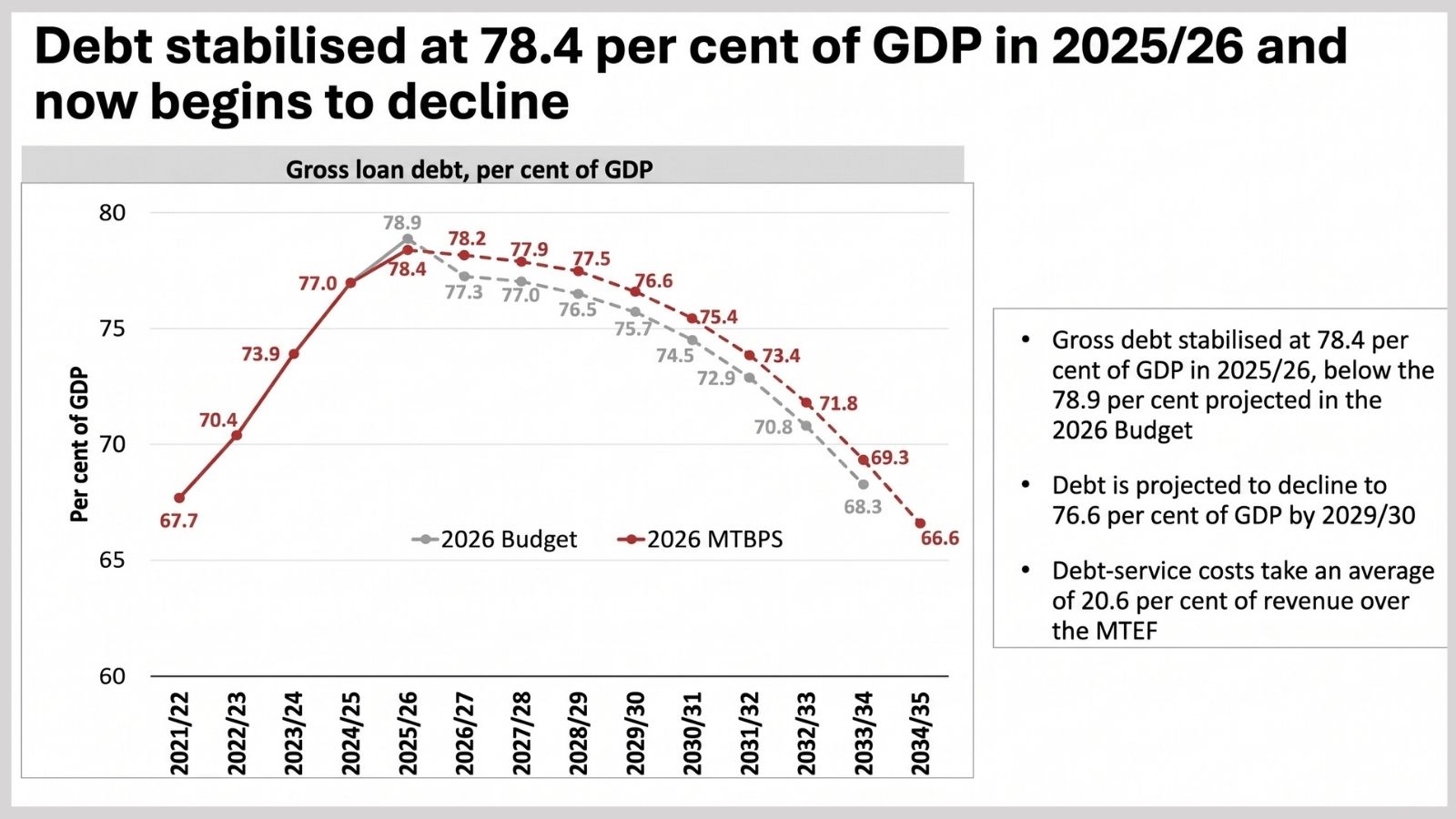
The debt-to-GDP ratio has leveled off at 78.4% in the 2025/26 financial year and is on a downward trend, marking a critical achievement after years of increasing debt.
“Debt as a percentage of GDP is now falling, creating a stronger foundation for investment, growth and job creation,” Godongwana remarked.
The budget deficit is anticipated to narrow to 3.9% of GDP in the current fiscal year, an improvement from the 4% forecast made in February. It is expected to decrease further to 2.5% by 2030.
The primary budget surplus, which reflects the government’s revenue against expenditures excluding debt service costs, is projected to rise from 1.7% to nearly 3% of GDP by 2030.
The 2026/27 tax revenue estimates have been adjusted upward by R17.1 billion, largely supported by corporate tax, VAT, and elevated commodity prices.
Government spending is expected to increase from R2.7 trillion this year to R3 trillion by the fiscal year 2029/30.
Temporary fuel relief from November
Godongwana has declared a temporary reduction in fuel levies amounting to R10 billion, aimed at assisting households and businesses facing rising fuel prices.
The fuel levy will be decreased by R3 per litre for diesel and R1.50 per litre for petrol from 4 November to 1 December 2026.
This reduction will continue from 1 December 2026 to 5 January 2027, at R1.50 per litre for diesel and R1 per litre for petrol.
The plan is designed to offer short-term financial relief while maintaining the government’s efforts towards enhancing public finances.
“This intervention will help ease cost of living pressures without compromising the sustainability of the budget,” Godongwana concluded.
Social grants and child nutrition receive support
Social expenditure constitutes a significant part of the budget, accounting for 60% of non-interest expenditure.
More than 11 million households benefit from essential services at no cost, which include water, electricity, sanitation, and refuse collection.
The government funds 18.1 million social grants for the elderly, disabled, and children.
To combat malnutrition and promote proper growth, the government has allocated R1.6 billion over the medium term for child nutrition, emphasizing maternal care and early childhood development.
Additional resources to combat crime and gender-based violence
Godongwana has earmarked R3.8 billion to recruit over 3,500 social workers aimed at addressing gender-based violence and providing support to victims.
The number of sexual offence courts will increase from 55 to 101, and the Thuthuzela Care Centres that aid survivors will grow from 72 to 80.
Moreover, R810 million has been allocated to upgrade the South African Police Service vehicle fleet, with an additional R823 million designated for military operations targeting gang violence and illegal mining activities.
Digital services and municipalities receive funding
The government is also investing R150 million to develop the MyMzansi app, which aims to provide citizens access to various government services via their smartphones.
Over the medium term, municipalities will receive an extra R3.5 billion for smart meter implementations that will enhance billing accuracy and help in the management of electricity distribution.
Additionally, the local government’s equitable share will be supplemented by R21.8 billion to support basic services. Godongwana emphasized that funding for municipalities must lead to tangible improvements for residents.
“Every rand transferred to municipalities must translate into visible improvements in people’s daily lives,” he remarked.